

Targon Holds the Ceremony Before the Climb, Not After
Targon says its goodbyes before the climb, not after, because the region has learned not to expect anyone back. Riot has published a long first-person story about that day. It is called The Face in Her Stars, and the narrator is Tyari, a Solari acolyte and the frontrunner for alpha initiate in her class. She is not the one who wanted to go. Her shield-mate Shorin was.
Shorin has no interest in the reward. When Tyari argues that there are safer ways to earn an Aspect’s attention, Shorin cuts her off.
“I’m not concerned with any of that. I don’t want power. I don’t even want honor. I just want an answer.”
Source: The Face in Her Stars
Then Shorin falls during a drill, and the injury takes both futures away at once. “But now both paths are closed to me,” Shorin says, and tells Tyari to go instead. Tyari’s cousin Anua, a devotee of the Protector, refuses to bless the climb: “It is because I love you that I will not give you my blessing.” She changes her mind on the last morning and puts a Taric necklace around Tyari’s neck. Tyari asks whether it will protect her. Anua says she hopes so.
Read Riot’s own caption for the ceremony and Anua’s hesitation stops sounding superstitious.
“In a sacred farewell ceremony before climbing the mountain, those beginning their ascent are celebrated. This day marks the moment when the fate of their souls is placed into the hands of Targon. Most will likely never be seen again.”
Source: Targon: THE FAREWELL
The story ends there. Tyari finds two other outsiders at the farewell stones, agrees to climb with them, and the last line is about the crowd disappearing behind her. Riot wrote a whole story about the decision to cross and not a line about the crossing itself.
Put that next to the destination and the problem shows up immediately. The Celestial Realm sits directly above these people. Our Atlas entry for Targon Prime describes the city up there as “wrought from gold and silver,” the dwelling place of the Aspects. Riot has drawn its architecture and given its inhabitants a language called Celestial. And in the entire canon there is no account of a Runeterran making that climb and coming back down from it. Every crossing on the record runs the other way, downward, and every one of them is paid for with somebody’s body.
Riot Named the Cinematic “The Vaulted Road.” The Line Inside It Is “There’s No Path.”
Targon’s entry in the Tales of Runeterra series is titled after a road. The climactic beat is a Lunari and a Solari standing at a crossing neither of them can see, and the line Riot gives them there is three words long.


“There’s no path. What do we do? Have faith.”
Source: Tales of Runeterra: Targon, “The Vaulted Road”
That is not mood-setting. It is the mechanical fact about this mountain, and the region gallery states it flatly.


“some climbers say Mount Targon seems to expand and contract beneath them, as if the rock itself were alive. This has always made it impossible to map any reliable path to the summit”
Source: Targon: JOURNEY UP THE MOUNTAIN
Because the route cannot be surveyed, the climb is not travel. Riot says so directly in the next panel: “the most dangerous thing about Mount Targon is not the incredible altitude, but the way in which it challenges the very character of each climber.” An ascent that grades your character is an examination wearing a road’s clothes.
The giveaway is what Targon actually points its instruments at. This is a civilization of astronomers with astrolabes and a professional class of scryers, and none of that apparatus is aimed at finding a way up.


“Astronomers and astromancers across Targon meticulously track the sun, moon, and stars, hoping to reveal the will of the Aspects and hasten their coming to this world.”
Source: Targon: ZENITH ARRAY
Hasten their coming. The Golden Astrolabe panel says the same thing in Solari terms, priests “using astrolabes to predict future events by measuring the movement of specific celestial bodies.” Targon’s whole science is an arrivals board. Even Mountain Scryer, the one job title in the set that sounds like cartography, describes the stars as “a constant, a way to chart our path.” A constant you steer a life by is not a route to anywhere.

And the road the title promises does exist. It just runs sideways.


“The oldest paths through the mountains are marked by ancient gateways of glittering metal, the largest of which have come to mark the end of each phase of the Rakkor’s migration.”
Source: Targon: THE VAULTED ROAD
The Vaulted Road is the migration circuit at the base, where the Rakkor “migrate between the solstices to remain in its heavenly light all year round.” Riot’s only named, gated, ceremonially crossed road in Targon is a loop that returns you to where you started. Nothing in the region is engineered to get anyone up.
Which Makes the Summit a Hiring Counter, Not a Destination
If there is no route, the thing at the top is not a place you arrive at. It is a position you are screened for. Legends of Runeterra prints the screener as a landmark, and the flavor text is unusually blunt about what the encounter is.


“Standing watch at the gate to the Celestial Realm is Targon’s crystalline guardian. Things fall away in it’s presence - hope, doubt, fear. Its trials strip all mortal concerns, and lays bare the essence of the climber’s soul. It is on this that they are judged, for the guardian is the great arbiter.”
Source: Targon’s Peak, Legends of Runeterra
A gate, a guardian, an arbiter, and a judgment. That is a border post, and The Destroyer staffs the far side of it: “To safeguard the spaces between land and sky, a horned guardian was placed in the stars over the mountains. Sturdy and swift, it traverses the night sky in search of intruders.” Somebody up there is worried about people getting in.
The direction of travel is the part Riot never hides. Our encyclopedia entry for the Rakkor records what the first climbers found waiting for them.
“At the summit they found not gods but the Aspects, otherworldly beings who cannot cross into Runeterra unaided and who bargain dearly for mortal hosts.”
Source: Rakkor, RuneGrove encyclopedia
Read that again with the mountain in mind. The constraint is not that mortals cannot climb out. It is that the Aspects cannot get in. Their own entry describes the workaround without euphemism: “Rather than walk the world themselves, they take mortal vessels: a climber who reaches the summit and proves worthy may be chosen and merged with the Aspect. The bond varies, for some hosts keep their identity while others are all but overwhelmed.”

“In the rare event that a mortal reaches Targon’s peak, the heavens open before them in a dazzling display of cosmic aurorae. Few ever bear witness to that radiant sight, far above the cloudline and beneath the glittering stars, where it is said that timeless, godlike beings dwell in a wondrous city of gold and silver.”
Source: Targon: REACHING THE SUMMIT
You see the city. Riot is careful never to write you into it. Our Mount Targon Summit entry calls the summit “the place where mortals meet the Aspects, standing face to face with the beings of the celestial realm.” Face to face is a counter. The successful applicant does not get a visa. They get hired, and the employer moves in.
Pylas Paid at That Counter and Got Nothing. Atreus Paid and Lost the Body.
Two men climbed together after the Aspect of the Sun refused to deal with a barbarian incursion. Only one of them reached the top, and Riot spends a single clause on the other.
“Like so many before them, they underestimated how arduous the ascent would be, with Pylas shivering his last upon finally reaching the summit.”
Source: Pantheon, biography
Pylas made it. That is the detail people skip. He completed the climb the entire region is organized around and it bought him nothing, because reaching the counter is not the same as being hired. Atreus was hired, and the terms were worse.
“Judging Atreus unworthy, a warrior who had known only defeat, it had taken control of his body to pursue its own ends.”
Source: Pantheon, biography
“Cast into the furthest corners of his own mind,” Riot writes, Atreus watched the Aspect of War drive his hands around the world hunting Darkin. He got the body back only because Aatrox killed the tenant, and what he was left with is the flat line in our Atlas entry for the realm: the power connecting him to the celestial realm was gone, leaving him only a man.
Legends of Runeterra prints the same invoice from the vessel’s side. Mihira is a mother, and she itemizes what the divinity cost her.

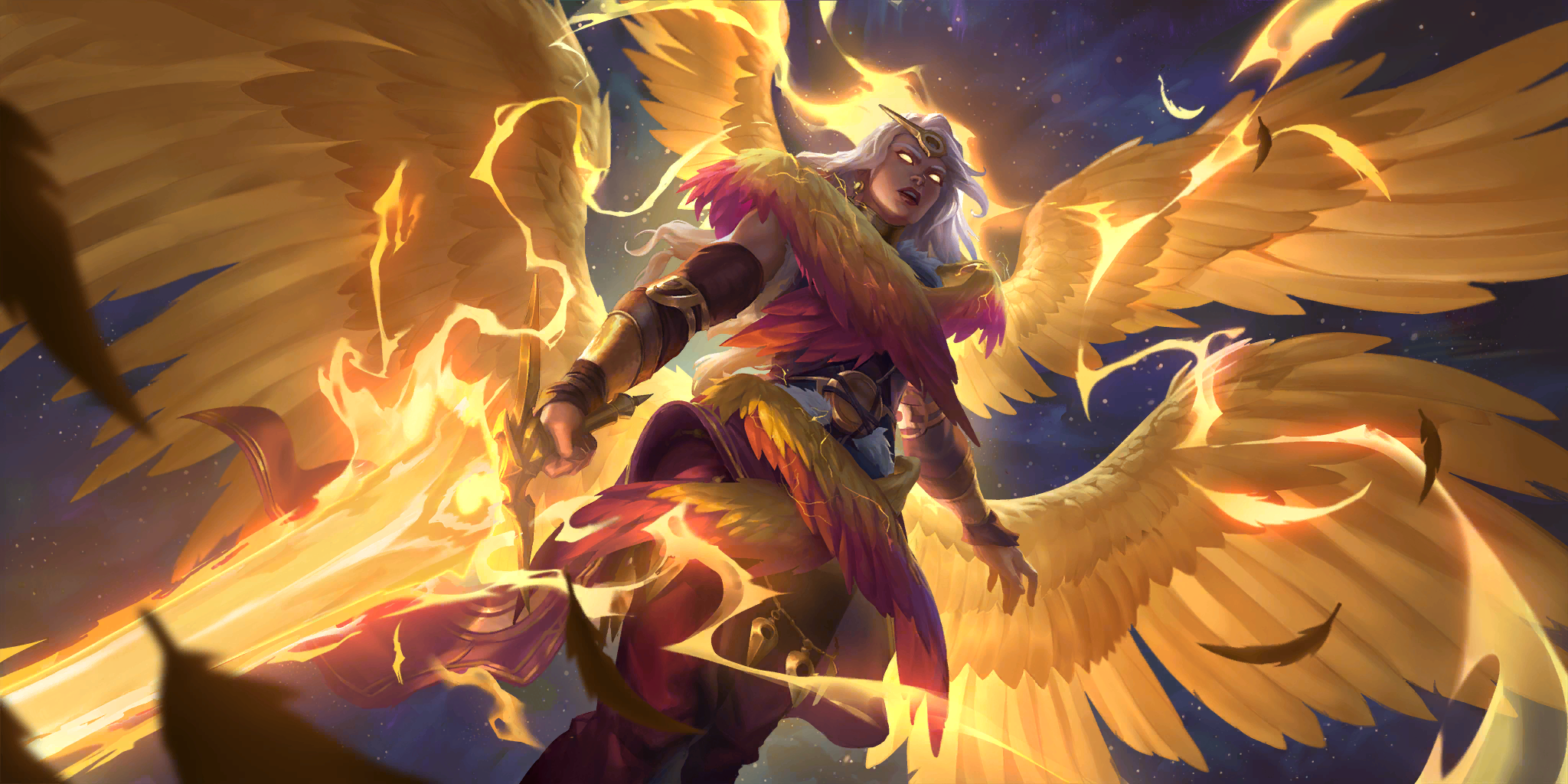

“It was in the names of my daughters that I embraced divinity. It was for my family that I forsook my own humanity, so that by this flaming sword I could forge anew a world of truth and justice.”
Source: Mihira, Aspect Ascendant
Her earlier card, Mihira, Aspect of Justice, quotes a lorekeeper who cannot get Targon to agree on what the Aspects even are: “Some revere the Aspects as gods. Others see them as messengers from the realm beyond. Still others fear them... and perhaps rightly so.” The same set puts Xolaani the Bloodweaver a few numbers down, a Darkin whose flavor text is a body count phrased as bookkeeping: “Another heart to control. Another body to command.” Riot has thought hard about what it means to wear a person.
Then the Aspect of Twilight Opened a Portal for a Girl Who Ditched Class
Everything above holds until you read Zoe’s biography, and then the argument flips.
Zoe did not climb. She was running from her teachers after skipping her studies, got cornered against a cliff, and was offered six objects by a watching Aspect: “a bag of gold coins, a sword, a completed study book, a devotion rug, a silk rope, and a toy ball. Five of these items could have let her flee, or otherwise defuse the situation. Zoe chose the sixth option.” She kicked the ball at a wall and laughed while it ricocheted among the priests.
“it opened a shimmering portal to the apex of Mount Targon, offering the girl a chance to see the universe.”
Source: Zoe, biography

So the door can simply be opened. It opens instantly, from the far side, for a child with no training and no interest in the reward, while Pylas shivered his last at the top of the sanctioned route. Riot does not soften this. The bio calls it out: “it was unheard of in all the myths and legends of Targon.” And the gallery panel for the normal procedure keeps the descent language intact, an Aspect that “may descend from the mountain within the body of a climber they have deemed worthy.”
Distance was never the barrier. Altitude was never the barrier. The mountain is a permissions check, and the entity holding the permissions is on the other side of it and answers to nobody. Zoe’s own cards are the joke at the end of the argument: the only chart in the set belongs to her, and it is nonsense.


“And these three EXTRA sparkly stars I call... “The Celestial Jump Rope”! Or is it more of an upside down happy face?”
The Only Map of the Far Side Is Cut Into the Rock, and the Rock Is Full of Climbers
If nobody can chart the way up, the obvious question is what the Rakkor think they are looking at when they look at their own mountain. Riot answers it across three gallery panels, and the answer is grim.


“it is sometimes easy to overlook the strange patterns that seem to flow outward through the rock from Mount Targon. To the ancient Targonians, these patterns were proof that the mountain itself was forged by divine intelligences.”
Source: Targon: UNNATURAL FORMATIONS
What those shapes mean is one of the few points where the accounts openly vary, and Riot leaves it unresolved.
“Some Rakkor now believe these otherworldly shapes were once part of a great map, depicting unknown realms beyond the heavens. Others say the markings warn of terrible war that will one day ravage the entire world, setting brother against brother. Despite such wild speculation, the true origin and purpose of these patterns remains a mystery to all.”
Source: Targon: WRITTEN IN STONE
One reading calls the carvings a map of the realms beyond. That is the only cartography of the Celestial Realm anybody in Runeterra has. And the next panel over, Riot explains what else ends up inside those same shapes.

“The bodies of the dead do not tend to decay at such heights, but seem to gradually meld with the rock, becoming twisted into the circular patterns and ridges of the mountain.”
Source: Targon: PATTERNS OF THE DEAD
It is a named place on our map. Patterns of The Dead is a location entry in Targon, currently active, which means the mountain’s casualty record and its supposed map of the heavens are the same stone. Failing the crossing does not remove you from the story. It files you into the diagram.
Succeeding does the same thing in a nicer font. Two Celestial spells say so.
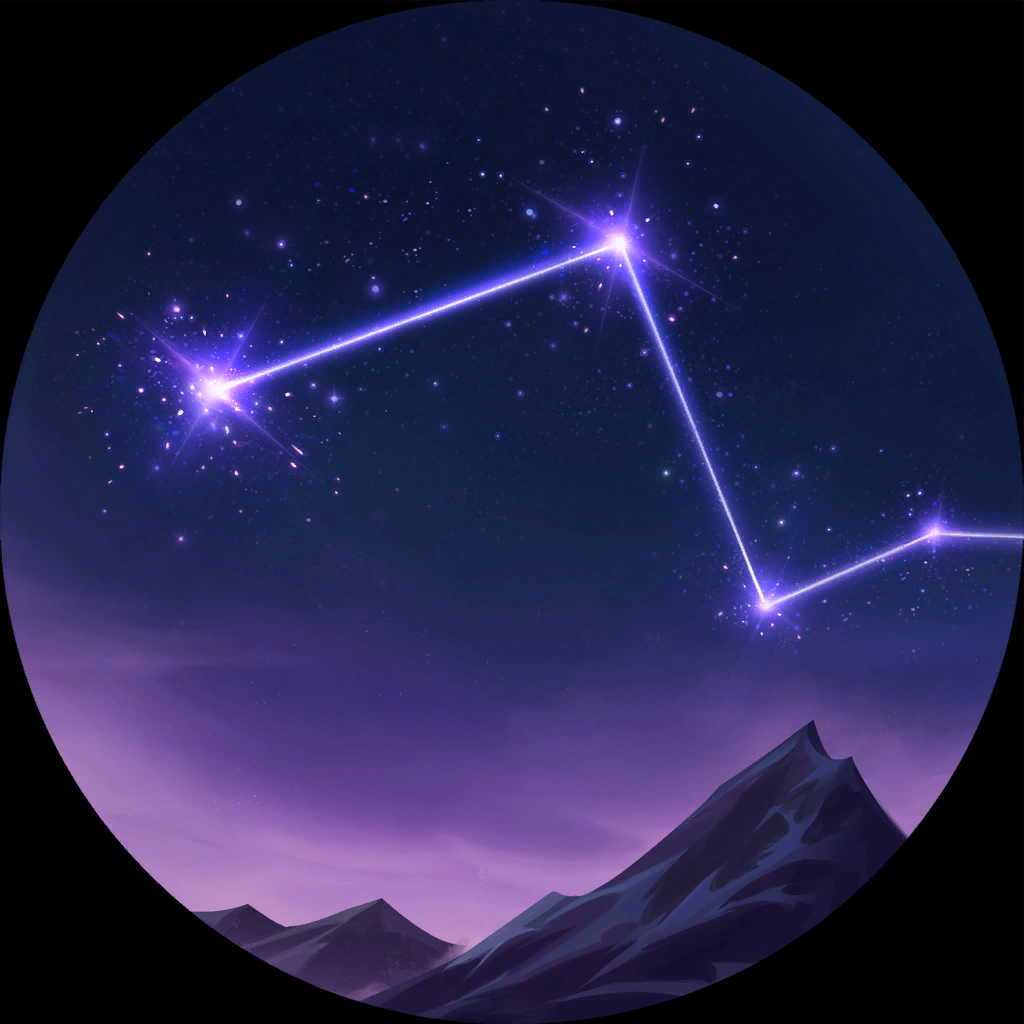

“there are some mortals who strive to achieve a higher purpose, and if the mountain deems them worthy, they may rise to become one with the stars themselves.”
Source: Written in Stars, Legends of Runeterra
Living Legends finishes the thought: “They say that some constellations were once mortals whose exceptional exploits earned them a place amongst the stars.” So there are two exits from Mount Targon and both of them convert a person into a pattern, one in rock and one in sky. Atreus is the proof that Riot is tracking this deliberately. He was “named after a star in the constellation of War,” which is to say he was named after somebody who might already have been through the door.
Targon Cut That Same Pattern Into a Crown and Used It to Lock a God Out
Here is where the piece’s two threads meet. The patterns are Targon’s only rendering of the far side. Targon has used that rendering exactly once as an engineered object, and it was not a map.
Aurelion Sol is the one being in the canon who came down to Runeterra in his own body and could have gone back up whenever he liked. He was born in the celestial realm, filled it with stars, found the Aspects dull, and descended of his own accord when they flattered him into it. The mortals of Targon met him at the peak with a gift.


“The mortals climbed to the peak of their tallest mountain, and presented him with a splendorous crown, crafted with careful and cunning magic, and etched with the inscrutable patterns of the celestial realm.”
Source: Aurelion Sol, biography
Etched with the inscrutable patterns of the celestial realm. The same motif that flows out of the mountain, that the dead are absorbed into, that one faction of Rakkor reads as a map of unknown realms. Targon’s single documented use of it was a restraint, and it worked.
“the power of the crown hurled him back into the heavens, and prevented him from getting any closer to that world again.”
Source: Aurelion Sol, biography
The profit motive is on the record too. With him leashed, the Aspects “channeled his celestial power to raise up immortal god-warriors, for some unknown conflict that was apparently still to come.” They needed a power source, they had no way to reach one, so they had mortals build a disc and a crown and hand the crown over as an offering. Starshaping still carries the line from before he understood what had happened, “Look to the stars. If you’re lucky, I’ll look back.” The Skies Descend carries the line from after: “When the time comes, I think I’ll make an example of Runeterra.”
Targon’s most sophisticated documented piece of engineering is a lock, and the pattern it is cut from is the closest thing anyone in Runeterra has to a picture of the place on the other side.
Riot Knows How to Write a Two-Way Door. It Gave That One to Somebody Else.
None of this is a limitation of Riot’s imagination, which is why it reads as a decision. Elsewhere on the same mountain there is a functioning channel between realms, and it belongs to a different pair of people.


“It is here, in the Spirit Realm, that Alune communes with her brother Aphelios. It is she who speaks words of comfort to the silent assassin, and who reaches through the veil to hand him his weapons of retribution.”
Source: The Veiled Temple, Legends of Runeterra
Our entry for Marus Omegnum has the fortress resting in the spirit realm and phasing into the physical world when celestial cycles turn, accepting a single occupant each time. Objects pass through it in both directions. That is a door with hinges, and Riot put it in the spirit realm rather than the celestial one.
Every crossing into Runeterra that does work carries the same clause. Soraka came down voluntarily and “took on a form of flesh and blood, and though the powerful magic coursing through her veins burned this new body from the inside out,” she stayed. Bard crossed in Ionia and had to improvise a chassis, fashioning “a simple body from the trinkets and fabrics of a traveling shawm-player’s wagon, including a beguiling mask.” An Aspect borrows one. Soraka burns one. Bard builds one. There is no version of this trip that a body does not pay for.
And the destination itself will not hold still long enough to be drawn. The Celestial entry warns that “nothing about their nature maps cleanly onto mortal or spirit life.” Most inhabitants see the realm as a tapestry of starlight. Bard does not see it at all; for him it is a symphony. Dragon Roost puts the epistemology in one line: “But how would we mere mortals know? From far away, all we see is their light.”
So Targon’s Zone Is Not the Country Above the Cloud. It Is the Counter.
The thesis this piece started with resolves cleanly. The Celestial Realm is not a region Riot forgot to draw. It is a door Riot drew with great care from the wrong side, then documented the toll in four different formats.
Look at what is actually specified. The farewell ceremony, with a named cost and a family that may withhold its blessing. An ascent with no fixed route, that runs anywhere from a day to many months, and that tests character rather than endurance. A guardian at the top that judges you and is called the great arbiter. A hiring decision with two outcomes, rejection or occupancy. A severance clause, because the bond can be cut and leave you “only a man.” A body of failed applicants who become part of the terrain. That is a zone, a questline, a reputation track, and a permanent character consequence, all written down before anyone at Riot built a single asset for an MMO.
What is not specified is the country on the far side, and it never will be, because three of Riot’s own sources describe it differently. Which means the honest build is the crossing, not the destination. The Traveler already names the three barriers in one line of flavor text.

“we were separated only by the mountain, the journey, and a sea of stars.”
Source: The Traveler, Legends of Runeterra
The bridge angle usually asks who walks the player from the known map into the unknown. Targon has an answer and it is a strange one. The guide is Zoe, the figure who moves across that threshold most freely and the only one who comes back chatty, and she is constitutionally incapable of explaining anything. She returned from what felt to her like a year away to find centuries gone, and her account of the intervening history includes “the Spooky Ghost Party” and “the War for Sparkly Rocks.” A guide who has been everywhere and remembers it as jokes is a better quest-giver than a cartographer, because she can open the door without ever making it navigable.
The anti-guide is the dragon. Aurelion Sol could go anywhere and now cannot get close, and he is circling Runeterra waiting for the crown to finish falling apart. Riot has the whole thing on the shelf already: a threshold nobody can map, a doorman with a judgment, a price in flesh, a guide who cannot give directions, and a creditor overhead.
None of it is announced. Riot has never shown MMO gameplay and has said nothing about Targon, zones, or vertical content in it. This is a read of published canon and where it points, which is what our earlier piece on Targon’s snowline did for the region’s working economy. Treat the ceiling the same way the Rakkor do. Everybody talks about the top of the mountain. Nobody has been able to describe coming down from it.
Read Next
Everything Below Targon’s Snowline Gets Sheared or Eaten
The region’s working economy, and the job Riot wrote above the snowline.
RuneGroveNobody in Bandle City Can Read the Tree at Its Center
The other realm-crossing Riot built, and the town for the people its doors strand.
RuneGroveA New MMO Zone Runs 2,000 Meters Top to Bottom
What vertical space costs to build, from a studio that just shipped one.
RuneGroveThe Counter Is Hiring. Do You Sign?
If the Riot MMO shipped Celestial Realm as playable space, would you make the trip?
Nothing here is confirmed. Sources: our Atlas of Runeterra entries for the Celestial Realm, Targon Prime, Mount Targon Summit, Marus Omegnum and Patterns of The Dead; the Aspect, Celestial and Rakkor encyclopedia entries; Riot’s Targon region gallery; the biographies of Pantheon, Zoe, Aurelion Sol, Soraka and Bard; the short story “The Face in Her Stars”; Legends of Runeterra card text; and the “Tales of Runeterra: Targon” cinematic. A RuneGrove lore read.


