Source: Where Winds Meet Official Site. Verified against multiple sources; datamines and reports are labelled as such, not stated as fact.

What Happened
An MMO just shipped a zone you measure in meters of altitude instead of square kilometers, and it did it seven weeks after Riot put world traversal on one designer's desk.
Everstone Studio and NetEase have dated Hidden Mountain, the expansion that opens Where Winds Meet's Version 2.0, for July 23 UTC. The developer letter published July 19 puts a number on the part that matters: vertical exploration depth beyond 2,000 meters, spread across 4 main areas and 14 sub-regions.
The stack runs from underwater Mohist ruins and subterranean labyrinths, up through the mountain, to cities suspended in cloud. You move between those layers with Lightness Skills, climbing, gliding, and mechanical vehicles you craft yourself. That last one is the tell. A studio doesn't put player-built vehicles in a patch unless the map is big enough vertically that walking stops working.
The rest of the update is sized to match. A new faction called the Mohist Hill Sect arrives built on engineering rather than martial arts, set against the Qiongqi Artificers. There's a Divinecraft quest series, a Celestial Seize ability for manipulating mechanisms and terrain, and a Modulating Stone system that salvages spare Legendary gear. Gauntlets and the rope dart come in as weapons, plus a combined style called Bamboocut Kite. Clockwork bosses ask you to solve environmental puzzles mid-fight. Everstone says more than 10,000 interactive NPCs run daily routines in the region, and the whole thing lands under an "Eastern Steampunk" banner alongside a 2.0 visual overhaul.


The Details
- Hidden Mountain launches July 23, 2026 UTC and marks the start of Where Winds Meet Version 2.0
- The official developer letter is dated July 19, 2026
- Vertical exploration depth exceeds 2,000 meters across 4 main areas and 14 sub-regions
- The map spans underwater Mohist ruins, subterranean labyrinths, mountain peaks and cloud-suspended sky cities
- Traversal between elevations uses Lightness Skills, climbing, gliding and craftable mechanical vehicles
- The new Mohist Hill Sect is built on engineering and craftsmanship rather than martial arts, and opposes the Qiongqi Artificers
- New systems include the Divinecraft quest series, the Celestial Seize ability, and a Modulating Stone system for salvaging spare Legendary gear
- New weapons are gauntlets and the rope dart, plus a martial style called Bamboocut Kite that combines both
- The expansion adds over 10,000 interactive NPCs with daily routines
- New bosses include clockwork enemies that require solving environmental puzzles mid-fight
- The expansion is billed as an "Eastern Steampunk" aesthetic shift alongside a 2.0 visual overhaul
- Where Winds Meet is developed by Everstone Studio, published by NetEase Games, and is free to play on Steam
- Riot hired Brian Holinka as Principal Game Designer on its MMO in June 2026; press reporting states his remit includes player combat, world traversal, enemy behaviors, camera control and movement feel
What This Means for the Riot MMO
In June 2026 Riot hired Brian Holinka onto the MMO as Principal Game Designer. Press reporting on that hire was unusually specific about the remit: player combat, world traversal, enemy behaviors, and core character actions including camera control and movement feel. Traversal isn't buried in that list. It's a named pillar with a senior name attached. That same hire was worth reading a different way just yesterday, when Throne and Liberty turned PvP into seasonal matchmade 12v12 and put the spotlight on his combat and PvP record instead.
So Hidden Mountain lands at a useful moment. It's the clearest live demonstration this year of an MMO treating verticality as the content rather than the backdrop, and it ships the movement kit to go with it. Climbing, gliding and player-built vehicles were designed together, because a 2,000-meter zone falls apart if they weren't. Verticality is a traversal problem long before it's an art problem.
Here's why that should interest anyone watching Riot. Runeterra was written to demand exactly this, and it was written that way years before anyone had to build it.
Targon is a climb, and Riot has been drawing it that way for a decade
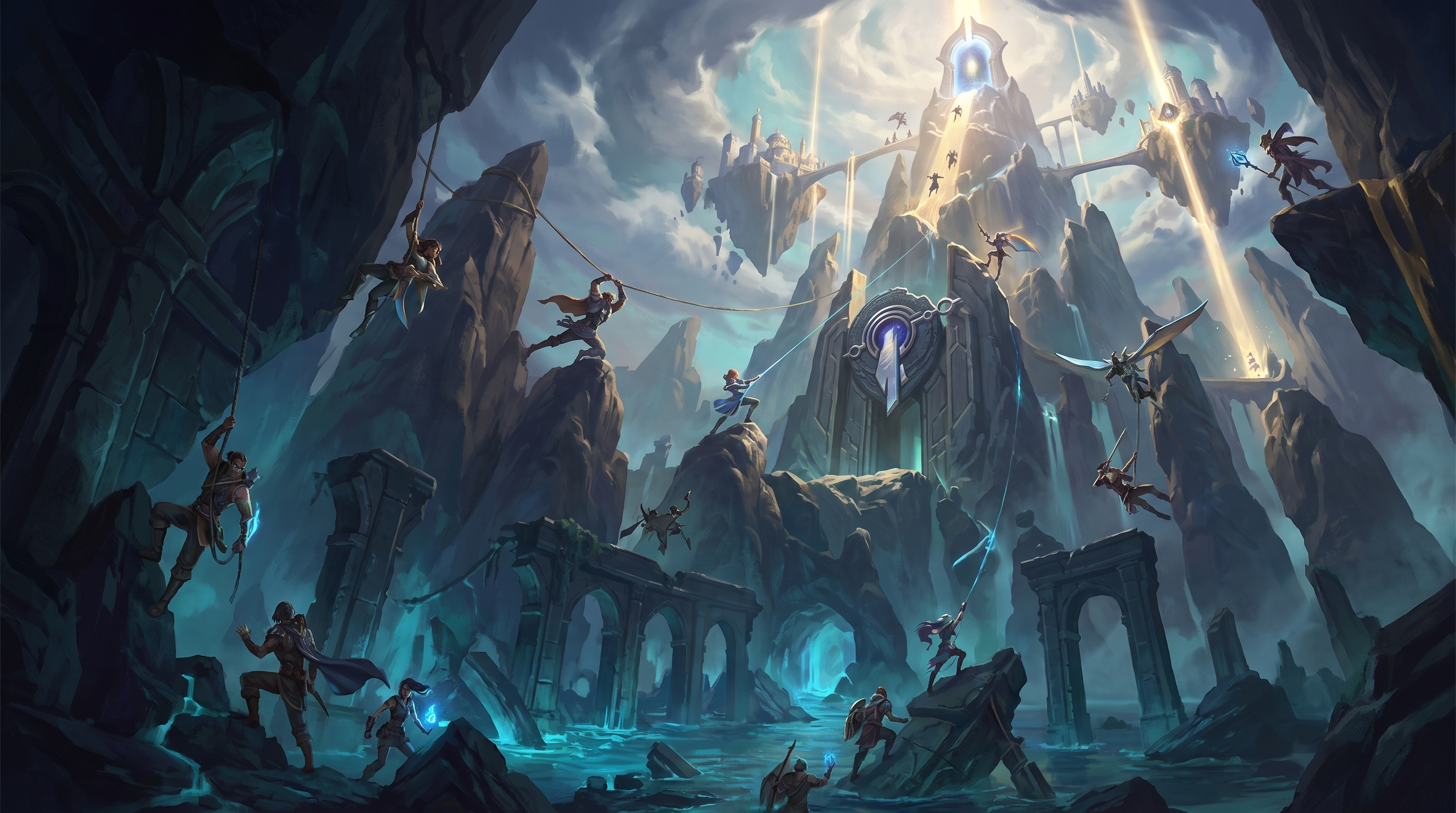
Look at Riot's own region art. This is not a studio that drew a mountain and moved on. It drew the gear you'd need, the road up, the settlements on the ledges, and the weather changing as you gain altitude.

Pilgrims carry real climbing kit up Targon. The mountain is treated as terrain to be solved, not scenery.

The ascent is the story of the region. Pilgrims are shown mid-route, not at a destination.

A built path up the slope, which is what a traversal designer would call a critical path.

Settlements clinging to the cliff face. Habitation stacked by altitude, not spread across a plain.

Climate changes with elevation, the same way Hidden Mountain shifts biome as you climb.

The top of Targon is a destination with a gate on it, reached by going up.
Every one of those pieces is a traversal brief. Climbing gear implies a climbing system. A vaulted road implies a critical path with shortcuts off it. Settlements on a cliff face imply hub design where the neighbor above you is a rope away instead of a jog away.
The other number: 10,000 NPCs on routines
Hidden Mountain's density claim is the quieter benchmark. More than 10,000 interactive NPCs running daily schedules is what a modern open world is now expected to feel like when you log in. It's the same problem from the other end as Erenshor filling its raids with bots that recruit each other into guilds. One studio is populating the world so it feels lived in, the other is populating the group finder so it feels playable, and both are answering the question of what happens when a player logs in alone on a Tuesday.
What we actually know, which is very little
- Verticality is a traversal problem before it is an art problem. A 2,000m zone only works when climbing, gliding and mounts are designed as one system
- Piltover over Zaun is a two-layer zone by definition, and Targon is a vertical zone by definition. Whichever regions Riot does build, the fiction for those two already sets the bar
- Holinka owning combat and traversal together points at movement and fighting being one system rather than two
- Player-built vehicles are a crafting sink that doubles as exploration content, which maps cleanly onto Hextech and chem-tech
- 10,000 NPCs on daily routines is the density benchmark a new open world gets measured against now
Your Take
Should the Riot MMO build Targon as a genuinely vertical, climbable zone rather than a flat map with a mountain in the skybox?
Reported from Where Winds Meet Official Site and corroborating coverage. The MMO read is ours and clearly speculative. Analysis by RuneGrove.