

A Solari Acolyte Describes Her Own Footwork as a Bird That Eats Livestock
A Solari acolyte borrows the mountain's apex predator to describe her own body, then looks down at the flock that predator hunts.
Tyari is the frontrunner for alpha initiate in her Solari class, and when she narrates the way she closes on a sparring partner she does not reach for a soldier. She reaches for a bird.
Crouching low, armored boots scraping across the tamped earth, I slowly advanced like a hungry bolor.
Source: The Face in Her Stars, Riot short story
The bolor is not a figure of speech on that mountain. It is a real predator with a real diet, and the animals it eats belong to Tyari's neighbours. A few minutes after the drill she walks to the lip of the plateau, and there they are.
Shepherds led flocks of goats and tamu in the valleys. I glanced back at the great mountain, looming in the near distance.
Source: The Face in Her Stars, Riot short story
Those two lines are the whole of Targon's wildlife as most Rakkor ever meet it. A hunter overhead, a flock below, and a mountain behind both that everyone keeps turning to look at. What nobody in the story says out loud is what happens to the animals if you follow that look upward.
Riot has written it down, in the region's own art gallery and across a decade of card flavor text, and the answer is odder than a bare tundra. The higher you climb Mount Targon, the less any animal is worth to you, until near the top the only transaction anybody has on record is handing one back.
Everything in the Valley Is on a Calendar, Down to the Shearing Dates
Wool sheared twice a year, milk counted a delicacy, and a goat whose horns shed gems on impact.
Start at Tyari's altitude. The Targon gallery is unusually concrete about what the low country supports, and it reads less like scene-setting than like a survey.
In the low-lying valleys, the Rakkor can easily hunt and forage, grow crops, and tend their herds. During spring and summer in particular, the local flora and fauna are known to thrive even at higher altitudes.
Source: Mount Targon gallery, FOUR SEASONS

The herd animal is the tamu, and its entry does something most fantasy bestiaries never bother with. It gives you a frequency.
Flocks of tamu are raised by the Rakkor. Their lush coats are sheared twice yearly, and woven into warm clothing and other textiles.
Source: Mount Targon gallery, TAMU

Twice a year is a schedule. Somebody in that chain knows the date, owns the shears, and sells the cloth, and Riot drew the animal in harness next to a robed human silhouette so an artist downstream would know how big to build it. The tamu is livestock with a paper trail.
One rung rarer, the ibik reads like a rare spawn somebody already tuned.
Ibik are rare, solitary herbivores from the lower plains of Targon, where their sweet, fatty milk is considered a delicacy. During its annual hibernation, an ibik’s rough, slate-colored skin can help disguise it amongst the boulders, and they often end up completely covered by the winter snowfall.
Source: Mount Targon gallery, IBIK

Rare, solitary, seasonal, camouflaged against the terrain it sleeps in, and carrying a luxury good. That is a gathering loop with a window on it, written years before anyone needed one.
Then there is the goat, which Riot went ahead and gave a drop table. Mountain Goat creates a Gem in your hand every time it strikes, and its flavor text explains why: the horns are made of the stuff.

The goats of Mount Targon are even more dangerous than their ordinary cousins, for the gems that make up their horns embed painful shards upon impact.
Source: Mountain Goat, Legends of Runeterra
Our own bestiary carries 13 entries that name Targon somewhere in their range, and almost every substantial one of them lives at this altitude, attached to wool, milk or gemstone. Below the snowline, a Targon animal is a line in somebody's books.
The Mountain's Best Hunter Raids the Same Flock the Shepherds Keep
The bolor trills before it drops and prefers tamu that stray, which makes Targon's top hunter a herding problem rather than a boss.
Every working ecology needs something at the top of it, and Targon's is the bolor. Its gallery entry is the most specific piece of animal behaviour Riot has written for this region.
Famous for the trilling cry it emits before swooping for a kill, the predatory bolor moves in long, gliding leaps along thermal currents with aerodynamic feathered limbs, and loves to prey on stray tamu.
Source: Mount Targon gallery, BOLOR

Note what the sentence gives a designer. A tell before the attack, a movement mode tied to terrain, a body built for that movement, and a preferred target that is somebody's property. The bolor is filed as sentient rather than a beast of pure instinct, and Riot's sheet puts a robed human next to it whose head does not reach the bird's shoulder.
Which is why Tyari's simile lands the way it does. Her class learned to describe an attack using the animal that raids their livestock, because that animal is the most dangerous thing anyone in the valley has to plan around. Targon's apex predator is not a dungeon. It is an insurance problem with feathers.
It is also the last thing on the mountain you are allowed to fight.
Riot Marked the Altitude Where the Animals Run Out, and Named What Hunts There Instead
The region's own captions thin the fauna to nothing on the upper peaks, then hand the danger to the climber's memory.
Keep climbing past the pasture and the gallery captions change register. They stop describing species and start describing absence.
Among the tallest peaks, bitter winds and perilous snows overcome the seasons, creating an everlasting winter. This unnatural landscape is perilous to any stray wanderers, with plants and animals becoming rare sights indeed.
Source: Mount Targon gallery, ETERNAL WINTER OF THE MOUNTAINTOPS

Look at the painting under that caption. Riot spent a species sheet on the valley and then, for the high peaks, delivered a vertical canyon of carved rock with one human speck standing in it. The bestiary does not thin out gradually. It ends.
What takes over is not a bigger animal.
However, the most dangerous thing about Mount Targon is not the incredible altitude, but the way in which it challenges the very character of each climber. The Rakkor regard the ascent as a trial of an aspirant’s spirit, as the inevitable solitude becomes unendurable and they suffer maddening, distracting visions of other times, places, and personal regrets.
Source: Mount Targon gallery, OTHERWORLDLY PERILS
Above the snowline the mountain stops offering things to kill and starts offering things to doubt. The threat becomes the climber's own memory, and the only thing left on the slope that used to be alive is the previous climbers.
Above the snowline the mountain stops offering things to kill and starts offering things to doubt.
The bodies of the dead do not tend to decay at such heights, but seem to gradually meld with the rock, becoming twisted into the circular patterns and ridges of the mountain.
Source: Mount Targon gallery, PATTERNS OF THE DEAD

Patterns of the Dead is filed as a place rather than an event, which is the correct call. It is the one part of the high mountain with a reliable population. So if there is nothing up there to hunt, what is the content?
The Only Job Anyone Is Named For Up Here Is Giving the Animal Back
Lidari catches falling stellacorns in order to return them, and the Star Shepherd asks to keep one and then puts it back.
There is wildlife above the snowline. It is simply not wildlife anybody is allowed to own. The clearest case is the stellacorn, which our bestiary files under the habitat mountainous celestial, near the very peak, and which Solari Stellacorn sums up in one line: stellacorns are born of stars.

Look at what that art is. A crater, still glowing, with a newborn animal standing in the middle of it. Riot drew the spawn point before anyone asked for one. And then Riot wrote the person whose job is to arrive at it.
Like any fledgling, young stellacorns must eventually take their first faltering flight. In this, they are just like other stars in the night sky, for they fall just as readily. Luckily, we are here to catch them, and when they are ready, return them.
Source: Lidari, Keeper of the Stars, on Fledgling Stellacorn
Catch them, and return them. Lidari holds a title, Keeper of the Stars, which means this is an office rather than a hobby, and on Resplendent Stellacorn the same voice spells out the terms of the arrangement.
While the young ones lend us their healing magic until they can be returned to the sky, grown stellacorns can wield that power on their own. It is considered very lucky to see one and know it for what it is. Luckier still to care for one.
— Lidari, Keeper of the Stars, on Resplendent Stellacorn, card page
Lend is the operative word. The magic comes to the mountain on loan and goes back up when the animal is grown, and the reward Lidari names for the whole business is luck.

The people who actually do the catching are Star Shepherds, and Riot names one of them. On Grandfather Rumul the flavor line reads, "Listen, Osu. Do you hear that? Bells! Grandfather’s back!" and it is signed Illi, Star Shepherd. Osu turns up again in the Star Shepherd's recorded voice lines, which are the closest thing this corner of Runeterra has to a field log.
Star Shepherd, on finding a fledgling stellacorn
Star Shepherd: “Look, Osu, another fallen star.”
Star Shepherd: “I hear tiny hooves~.”
Star Shepherd: “Can I keep this one, Osu?”
Star Shepherd: “We’ll put you back where you belong.”
Soraka, working the same fledgling
Soraka: “Silly little star.”
Soraka: “Oh! No, don’t eat that.”
Soraka: “Back you go, little one.”
Spring Guardian, who minds the springs and takes the escort anyway
Spring Guardian: “Ah. You must have wandered off.”
Spring Guardian: “I could tell you’re an unruly one.”
Spring Guardian: “Follow me, little star.”
Recorded Legends of Runeterra interaction lines, played when a Fledgling Stellacorn arrives alongside each unit. Tap to listen.
Run that first exchange again. She finds one, she counts it ("another"), she hears it before she sees it, she asks to keep it, and then she does not keep it. Two other units work the same crater and reach the same verb. Soraka gets it out of the animal's mouth and sends it home; the Spring Guardian, whose own card admits that "a shepherd’s responsibility is first and foremost to their flock," walks it back.
Nowhere in any of that does anybody name a price.
A Lunari Priestess Says the Answer Is Not to Catch It at All
A sparklefly, a crystal ibex and one line of Lunari doctrine put three incompatible policies on the same animals.
The Keepers are one policy, and the mountain does not agree on it. The counter-argument is printed on Sparklefly, a creature the encyclopedia files as a minor Celestial rather than an animal at all.
Hope is a delicate thing that flies ever higher, and should never be caught.
Source: Lunari Priestess, on Sparklefly
That is a doctrine, not a mood, and it is aimed directly at the Solari-facing Keepers who catch things for a living. There is a third position too, and it belongs to the climbers.
Those seeking to scale Targon would do well to befriend the local fauna. No creature is more familiar with Targon’s perilous gauntlet, and none can travel more swiftly across its icy terrain.
Source: Crystal Ibex, Legends of Runeterra
Befriend. The ibex is the animal a Targonian lullaby uses to calm a frightened child, and its other card, Frightened Ibex, is built so that supporting it makes it support you back. Riot has now printed three incompatible answers to the same question about the same fauna, and not one of them is skinning.


None of this is a coincidence of tone. Targon's central quarrel is about which light in the sky is the real one, and the sects on either side of it have opposite instincts about touching anything that came down from there.


Disciples are guided in the strictures of their faith by temple priests, who preach that if the sun was ever to fade, the world would be swallowed by darkness. Accordingly, the Solari stand ready to fight any who would extinguish its holy light.
Source: Mount Targon gallery, THE SOLARI
Now set that beside the sect they have branded heretical, whose priestess is the voice telling you not to close your hand on anything that flies higher than you do.
Branded by the Solari as heretics, the Lunari worship the silvery light of the moon.
Source: Mount Targon gallery, THE LUNARI
On this mountain, a wildlife policy is a theology. Which is the last thing you need to know before meeting the creature that broke the filing system.
Esmus Is What the Top of the Ladder Actually Pays Out
Her card is three drinkers calling each other liars about how she was born, and the game they are playing is the point.

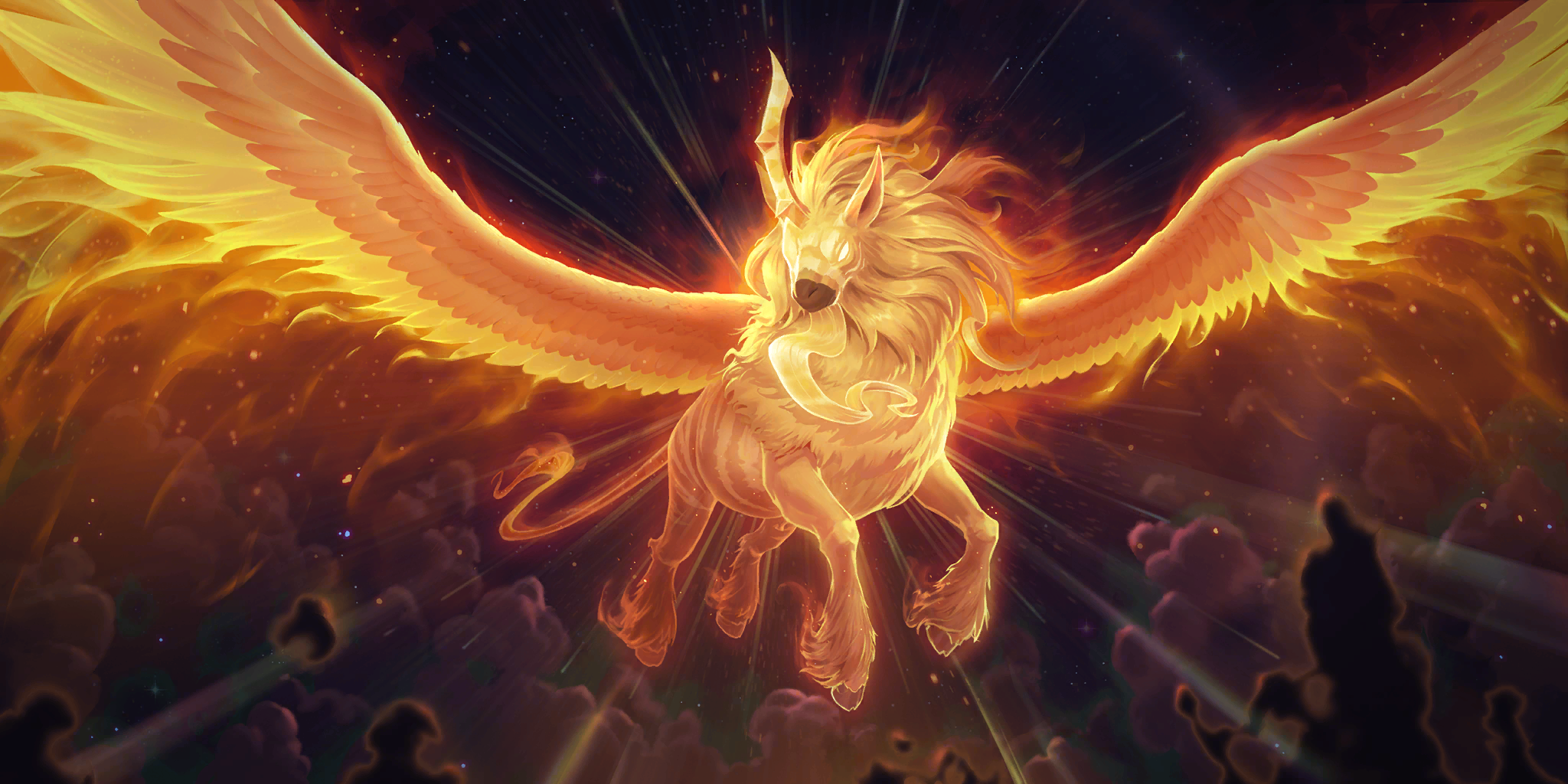
Esmus, Breath of the World is a two-cost Targon common, and her art is a spiral of gold wind with brass-capped pipes and round drum faces tumbling inside it. She has no bestiary entry, no habitat field. What she has instead is an argument.
"...but I heard Esmus was created by the Caretaker himself, and with her birth, sound came to the world!"
"I say lies! It is known that Esmus bears the face of an old singer who had the heart of an angel but the voice of the dead... until Bard himself granted her a voice of pure beauty!"
"I say lies! Esmus is..."
An instance of the Birth of Esmus, a popular bard’s game
Source: Esmus, Breath of the World, Legends of Runeterra
Read the last line first. This is not a legend with variants that a scholar could reconcile. It is a game, played for entertainment, whose rules are that everybody contradicts the last speaker. One account has Bard, the Wandering Caretaker, making her, and sound entering the world with her. Another has her wearing a dead singer's face until he gave her a voice. A third gets cut off. The canon does not pick.
Her card text is built the same way. She is Elusive, so ordinary things cannot lay a hand on her. She has Support, which means her whole contribution is standing behind an ally and making it bigger. And when she arrives she plants a Chime on the top card of your deck: she leaves an object behind and gets on with it.

On still windless nights, cast your eyes to the heavens and listen for the soft symphony of tinkling chimes. In that moment you will know that He is watching.
Source: Chime, Legends of Runeterra
Somebody has already filed the only first-hand report we have on what an encounter like that leaves you with. Old Gaff's tale runs across four cards in three regions, and it is the closest thing in Runeterra to a sighting log written by a witness who was running away at the time.
Part 1
Bard
Gaff sees the Caretaker go past "like a star streamin’ ’cross the sky."
Part 2
Byrd, The Bellringer
His dinner and his pots and pans walk out the door on two legs. He follows them to a temple.
Part 3
Mystic Vortex
Thousands of them singing, a flash of light, temple gone. Gaff is left holding a chime.
Part 4
Maduli, The Gatekeeper
"Arms sproutin’ all over. Teeth big as boulders." Then holes in the sky, hundreds of them.
Part three is the part that matters here, in his own words: "And in me hands? Well Old Gaff was left there holdin' a chime." An entire temple went with them. He kept one object nobody can appraise, and a story his neighbours are free to call lies.
That is the same transaction three drinkers are having over Esmus. The valley pays in wool and milk and gemstone horn, on a schedule, to people who own the animals. The summit pays in a chime and an anecdote, to one person, once, and the receipt is worthless to anyone who was not standing there.
What a Targon Hunting Zone Would Have to Be
Two stacked economies with different verbs, split at the snowline. None of it is announced.
The interesting thing about this region is that it hands a designer two economies that cannot share a verb, and stacks them vertically so you cross between them by walking uphill.
The low half almost writes itself, because the canon already put dates on it. Shearing runs twice a year, so tamu wool is a windowed gather rather than a permanent node. The ibik hibernates and hides against the boulders, so finding one is a tracking problem with a season attached and a luxury good at the end. Goat horn is a strike drop that Riot has already costed in a card game. Above it, the bolor takes stray flock animals, which makes the region's apex predator a defence contract rather than a raid, and gives a low-level zone a reason to have players in it after week one.
| The two halves | Below the snowline | Above it |
|---|---|---|
| What the animal is | Livestock and game, with an owner | Somebody’s ward, on loan from the sky |
| What you take home | Wool, milk, gemstone horn | A chime, and a story |
| Who does the work | Shepherds and herders in the valleys | Keepers of the Stars and Star Shepherds |
| The season | Shearing twice a year; the ibik’s hibernation | Whenever something falls |
| The apex threat | The bolor, raiding the flock | The climber’s own memory |
| In the Riot MMO | Not revealed | Not revealed |
The top half needs a different verb, and the canon supplies it. There is no kill credit above the snowline because the gallery already said the animals are rare sights up there, and everyone Riot names at that altitude is in the business of putting things back. A stellacorn crater is a rare spawn where the objective is an escort upward. The reward is what Lidari says it is: standing with an order, and luck. Nothing you can post to a trade channel.
Then there is the fork, and it is already written as a war. The Solari-facing Keepers catch and return. The Lunari priesthood says never close your hand on it. A player who has taken a side on that question is a player who has taken a side on every celestial creature in the zone, which is a cleaner faction hook than most MMOs manage to invent from scratch.
And Esmus is the honest model for the last tier of it. Something you cannot block, cannot claim, and cannot prove you met, that leaves one chime behind and lets you go argue about it in a bar. Riot printed the argument on the card as a game with no winner, which is a strange thing to put on a common, and exactly the right thing to put at the top of a mountain nobody can map.
Would You Put It Back?
The Star Shepherd asks to keep one and then hands it back to the sky. Your call.
You find a fledgling stellacorn in a fresh crater on Mount Targon. Do you carry it back up?
Read Next
Three more reads on what Runeterra’s published canon already builds for a Riot MMO.


None of this is confirmed. Sources: the Mount Targon region gallery, the Riot short story The Face in Her Stars, and the Legends of Runeterra cards linked throughout, all Riot’s own canon. A RuneGrove lore read.


