
A Bench Hand Called Axel Was Told He Would Be Listed as Co-Inventor Once the Documentation Was Done
The Forge Worker card carries a promise about credit. The rest of the set carries the answer.
The most honest sentence in Piltover’s corner of Legends of Runeterra belongs to a token unit that nobody builds a deck around.
“Yeah so I’ve been ’elping Jayce an’ them lot ’tinker around with this new thing. Powerformative technology, we call it. Truth be told, Jayce said I’ll be listed as co-inventor once the documentation’s done! Them bigwigs know where the real smarts is, eh?”Flavor text, Forge Worker (05PZ023)
That is the body The Forge Of Tomorrow and Assembly Line put on the floor, and he has a name. Jayce uses it in the card’s own recorded lines: “Ha, will do, Axel.”
Axel turns up again on Jayce’s champion card, in a three-way exchange that reads like the middle of a shift rather than a press conference.
“So, Rosa, as you know, this powerformative tech promises to change the world.”
“Truly groundbreaking work, Jayce. The way those coinhiberators splice together. It’s breathtaking.”
“It sure is. All Axel’s idea, too! Right, my good man?”
“Well, you know me, mate. Don’t like to brag...”
Flavor text, Jayce (05PZ022)


Rosa is the Forge Chief. Jayce greets her by name in her recorded lines, and when she dies the game logs it as “Rosa groans.” So the conversation on the champion card is the crew: the inventor, the woman running the forge, the man on the tools. Jayce gives the idea away unprompted, in front of his own boss.
Jayce and the forge worker, recorded on the Forge Worker card
Jayce: “Hey Axel! Got a minute to explain Thermo-Dynamics to me?”
Forge Worker: “I can't now, mate. Gotta do smart stuff over 'ere!”
The same pair, the other way round
Forge Worker: “Lemme know if you still want them science lessons, Jayce!”
Jayce: “Ha, will do, Axel.”
Jayce and the woman who runs his forge
Forge Chief: “Well, if it isn't the 'Man of Tomorrow'!”
Jayce: “Hey, back to work if you don't wanna be the 'Lady of Yesterday'.”
Recorded Legends of Runeterra interaction lines. Tap a line to play it.
Three people credit each other by name. None of them ends up owning the work. The man who does never appears in the conversation.
Hextech Is Magic With the Bloodline Requirement Taken Out
Our Piltover gallery says these artifacts work for anyone. The catch is in the same sentence.

“Hextech is the newly emergent fusion of magic and technology used to create exquisite artifacts that can be wielded by anyone, not just those few with a natural aptitude for the arcane. It harnesses the magical power contained within extremely rare crystals, and its power is limited only by the imagination of their users.”Riot’s Piltover gallery, Hextech
Read that as a design document instead of flavor and it is the most unusual magic system Riot has written. Every other school in Runeterra asks something of you before you start. Hextech asks for a crystal.
The rest of the same entry names the job and prices the work: “The process of crafting hextech is a closely guarded secret, and no two artificers work to the same methodology. As such, each item of hextech is a unique artifact of rare beauty, a bespoke creation that will likely have taken years to craft.” Artificer is a job title. Years per item is a career.

Riot even wrote the prototype history. The gallery’s Hextech Cube Battery entry records that “the first attempt to capture crystalline power in portable form was the Hexahedral Configuration, with shards cut from the Odyn Valley.” A named early model, a named quarry, a stated failure mode. That is more crafting scaffolding than most fantasy settings ever bother with.
Which raises the only question that matters for a profession: if talent is not the entry requirement, what is, and who controls it?
Every Hex Crystal in the Twin Cities Holds a Sleeping Scorpion’s Memory, and One Clan Owns the Supply
Our bestiary says where the first crystals came from. Camille’s biography says how her family kept them.
The crystals are not ore. Our Brackern entry is explicit about what they are and where Piltover got them.
“At the heart of each Brackern is a namestone, a crystal that holds the memories, songs, and consciousness of every generation that came before it. Linked through a shared crystal network, the Brackern were a living repository of history, a lineage able to speak across the ages. To break one of these stones is to tear living memory from a sleeping being.”RuneGrove bestiary, Brackern
The same entry finishes the thought without softening it: human miners found the crystals while the Brackern were hibernating and began harvesting them, and “every hex crystal that powers the twin cities’ marvels holds the trapped consciousness of a Brackern.” The voices have not gone quiet either. Our entry records that the Piltovan songstress Seraphine first heard one through a crystal her parents gave her.
Skarner is the last of them, which is the part of this the MMO would have to reckon with if it ever let a player mine a hex crystal.
That supply is not a public resource. Clan Ferros is described in our own faction entry as a merchant house “whose fortune rests on its control of significant hextech crystal resources,” and Camille’s biography spells out both where the money came from and what keeping it required.
“Clan Ferros understands sacrifice. Most of the family’s wealth came through harvesting a rare crystal from the brackern, a creature native to Shurima. These hex-crystals, or ‘first crystals’, contained power normally only wielded by those born with innate magical ability.”
“It was only through espionage, intimidation, and murder that Clan Ferros held its monopoly on this priceless commodity, and ensured its uninterrupted production in Zaun.”
Camille’s biography, RuneGrove

Notice the middle clause of the first quote, because the whole craft turns on it. The first crystals carry power that would otherwise only belong to people born with it. Hextech does not abolish the arcane birthright. It bottles it and sells it. The gate did not disappear. It moved from your blood to your balance sheet.
The gate did not disappear. It moved from your blood to your balance sheet.
The biography also names the bill, and hedges it exactly as our encyclopedia does: the brackern were a limited resource, so the family developed weaker synthetic hex-crystals, and “synthetic crystal manufacturing has long been rumored to heavily contribute to the Zaun Gray.” That is a rumor in canon, not a finding, and it is worth keeping it that way. It is also the reason the twin cities are one region on a card and one problem in the fiction.
Riot’s official Piltover & Zaun Region Showcase, on the Legends of Runeterra channel. The card game files the two cities as a single region, which is the arrangement the crystal trade depends on. Our page: Piltover & Zaun Region Showcase.
Jayce Lists the Two Things It Takes to Get an Idea Off the Page, and Neither of Them Is the Idea
The Forge Chief card is Jayce’s own accounting of what an invention costs, and it does not price the invention.
Piltover’s best inventor did the accounting himself, on a one-mana common.
“Takes two things to get an idea off the page and into your hands. Funding’s one half of the equation, the other’s a good forge. And it’s not just the tools or the hardware in the forge; if your chief doesn’t have what it takes to run things, well, your idea’s staying on paper.”Jayce, flavor text on Forge Chief (05PZ025)

Money and a shop, run by somebody competent. Neither half of Jayce’s own equation is the idea. He assumes the idea, prices the delivery, and the delivery is where the leverage lives.
Neither half of Jayce’s own equation is the idea.
Rosa keeps the ladder visible in her recorded lines too. When Axel asks whether she wants them working, she answers “Well, that is what I pay you for.” Ferros pays Reginald, Reginald keeps the books, Rosa pays Axel, and Axel is the one waiting on the documentation.
Hextech Does Not Come Out Stable, Which Is Why Somebody Has to Buy the Failures
Jayce’s journal on crystals that would not cooperate, and a forge card that burns itself down to ship one invention.
The funding half only makes sense once you see how much of this work is wasted. Jayce’s journal, printed on a six-mana spell, is a description of a bad year.
“...configuring hextech into a stable state was the most difficult hurdle I faced. Most nights, it felt like the crystals and hexite were actively conspiring to trip me up, and it was only through extensive trial and error that I was able to get the component parts working in harmony...”Excerpt from Jayce’s journal, flavor text on Hextech Anomaly (05PZ030)
The card mechanic is the joke and the argument at once. Hextech Anomaly transforms itself into a random six-plus cost spell every round start while it sits in your hand. It will not hold a shape. You are holding an experiment, not a product.


The Forge Of Tomorrow makes the same point in stone: “If Piltover is a city driven by invention, then its forges are its engines.” It summons a Forge Worker when it lands, and the moment you play a six-plus cost spell it destroys itself and refills your spell mana. The shop burns down to deliver one thing, and the crew is standing in it.
6+ mana is the tell. Riot gated the entire Piltover archetype in this set on spells costing six or more, which is the game’s way of saying “a real invention.” Everything else in the deck is scaffolding around affording one.
Not all of it is grim. Hextech Handler was “initially constructed to transport raw materials through Piltover,” and the crew took to him: “Jayce’s forge crew nicknamed him Nugget, a Piltovan lord reportedly donated a hat, and passing kids now adorn him with whatever they have to hand.” The people at the bench name things. Keep that in mind for what comes next, because the people who fund the bench name things too.
Ferros Outbid the Clan That Raised Jayce
Jayce came up as Clan Giopara’s apprenta. The Albus Ferros card names who beat Giopara for his Hexgate research, in a spread the winner paid for.
Jayce did not come up unsponsored. His biography records the rung he entered on, and Piltover has a word for it.
“With a knack for understanding machinery, Jayce earned the honor of being the youngest apprenta to ever be offered patronage by Clan Giopara, one of Piltover’s most respected ruling clans.”Jayce’s biography, RuneGrove
Apprenta, then patronage. That is a career track with a named entry grade, and the promotion is not a skill check. Somebody has to offer.
Which is what makes the Albus Ferros card read the way it does. Giopara raised him. Ferros bought him.
“The magnanimous Albus Ferros has once again THRUST himself into the spotlight, dramatically outbidding Clans Cadwalder and Giopara for the rights to sponsor Jayce’s Hexgate research. ‘A fine day for Ferros is a fine day for Piltover’, as the saying goes, and yesterday was a very fine day for Clan Ferros, indeed!”Excerpt from a sponsored spread in the Piltover Daily, flavor text on Albus Ferros (05PZ031)
Two rival clans bid and lost. The thing being auctioned was not the research. It was “the rights to sponsor” the research, which is a different object, and it went to the highest bidder while the work was still in progress.
Then look at the byline. Riot did not attribute that to a reporter. It is “an excerpt from a sponsored spread,” which means Clan Ferros paid for the coverage of Clan Ferros winning. And the prize was the Hexgates, which our atlas calls the pinnacle of Piltovian engineering and the reason the city became the undisputed center of commerce in Runeterra.
If I Paid for It, Isn’t It Mine?
Albus says it in his recorded lines, and his corner of the set pays him for it three different ways.
Albus Ferros is not coy about the arrangement. He asks the question out loud, in a line the game plays when Jayce is on the board.
Albus Ferros, when Jayce is on the board
Albus Ferros: “Ah, my prized asset. Kind of you to meet me.”
Albus Ferros: “If I paid for it, isn’t it mine?”
Albus Ferros: “Yes. I want to see what you're doing with the Ferros Fortune.”
Albus Ferros and Reginald, the man who keeps his books
Ferros Financier: “I've got your balance books here, Mr. Ferros!”
Albus Ferros: “Show me results, Reginald, not numbers.”
Albus Ferros: “Give me progress, Reginald - or your resignation.”
Ferros Financier: “We're on track, Mr. Ferros - as promised.”
Two men look at the same airship
Albus Ferros: “The fruits of labor: Their labor, my fruit.”
Forge Worker: “Hm. I prefer walking meself.”
Recorded Legends of Runeterra interaction lines. Tap a line to play it.
“My prized asset” is the register. Jayce’s own journal answers it from the other side, on the Ferros Financier card: “About the only good part of Ferros financing my work was getting to team up with Reggie. Not only is the man one of the most competent people I’ve ever worked with, he’s a heck of a guy, too.” The best thing about the money was the colleague it came attached to.


Albus told the city exactly what he was buying, on the side of his airship.
“The people of this city worship at the feet of ‘intelligence’. But what good is the greatest mind without the means to express itself? No. I will show Piltover true greatness. It will tower over them. It will blot out the sun. And it will carry my name.”Albus Ferros, flavor text on Ferros Skycruiser (05PZ028)
Riot then wrote the arrangement into the rules text, which is the part that should make a systems designer sit up. Albus Ferros draws Jayce into your hand the moment he is summoned: the patron produces the inventor, not the other way round. His attack deals 3 to the enemy Nexus and increases by +1 for every 6+ cost spell you have played this game. The Skycruiser gains +2 attack once you have played one. Nugget and the rest of the Tech units get stronger on the same trigger.
Every hour of research you pay for makes the patron’s assets worth more. The token that carries the payout is called Ferros’ Dividend, and its flavor text is four words long: “First, the investment. Then, the dividend.”
Riot’s Caption for a Piltover Workshop Credits the Patron, Not the Inventor
One workshop caption, a second clan funding gate research off inherited patents, and the mark that goes on the invention itself.
It would be convenient to file Albus Ferros as one loud man. The gallery Riot wrote for a workshop that has nothing to do with him says the same thing in one sentence.

“Workshops of hextech researchers are magnificent examples of what a wealthy patron can do for an inventor.”Riot’s Piltover gallery, Workshop of the Horological Institute
The pattern repeats with a different house. Jago Medarda is “the current master of Clan Medarda,” and the gallery is precise about where his research budget comes from: “with the revenue generated by his father’s piston patents, Jago is funding research into using hextech to speed the opening and closing of the Sun Gates.” Patent revenue from the last generation buys the next generation’s research. Our Medarda Clan entry has a second Medarda on the books as well, and a card: Jae Medarda, the heir apparent who “preferred hunting ancient artifacts over managing the family business.”

And the ownership is stamped on the object. Our Mercantile Clans entry, and the gallery it draws on, put inventions on the same list as warehouses.
“The mercantile clans of Piltover each have their own unique sigil to identify their homes, workshops, shipments, warehouses, inventions, brands and places of business. Each sigil bears many meanings and interpretations; some obvious, some less so.”Riot’s Piltover gallery, Merchant Clan Sigils

So the city has two public faces and they point at different people. On the poster, Piltover sells the inventor: the Progress Day! handbill promises “HEXTECH WONDERS,” free entry, Piltovan children welcome, and the “MAN OF TOMORROW” speaking on the state of today. Rosa uses that same nickname to needle Jayce across the shop floor. On the machine, the clan sigil.

Even the region page files it plainly. Piltover, our region entry says, is a place where “burgeoning merchant clans fund development in the most incredible endeavors: grand artistic follies, esoteric hextech research, and architectural monuments to their power.” Research and monuments, in the same list, funded from the same purse. Riot put golden statues of the city’s greatest minds in the plaza where the reveals happen, and the clans paid for the plaza.
The Ledger Has No Room for Acorn, and the Academy Lost Viktor’s Records
Four cards about the bottom of the ladder, and a chronicler who does not believe the Council’s filing.
Riot keeps writing the same man, in four sets, and never puts his name on anything.


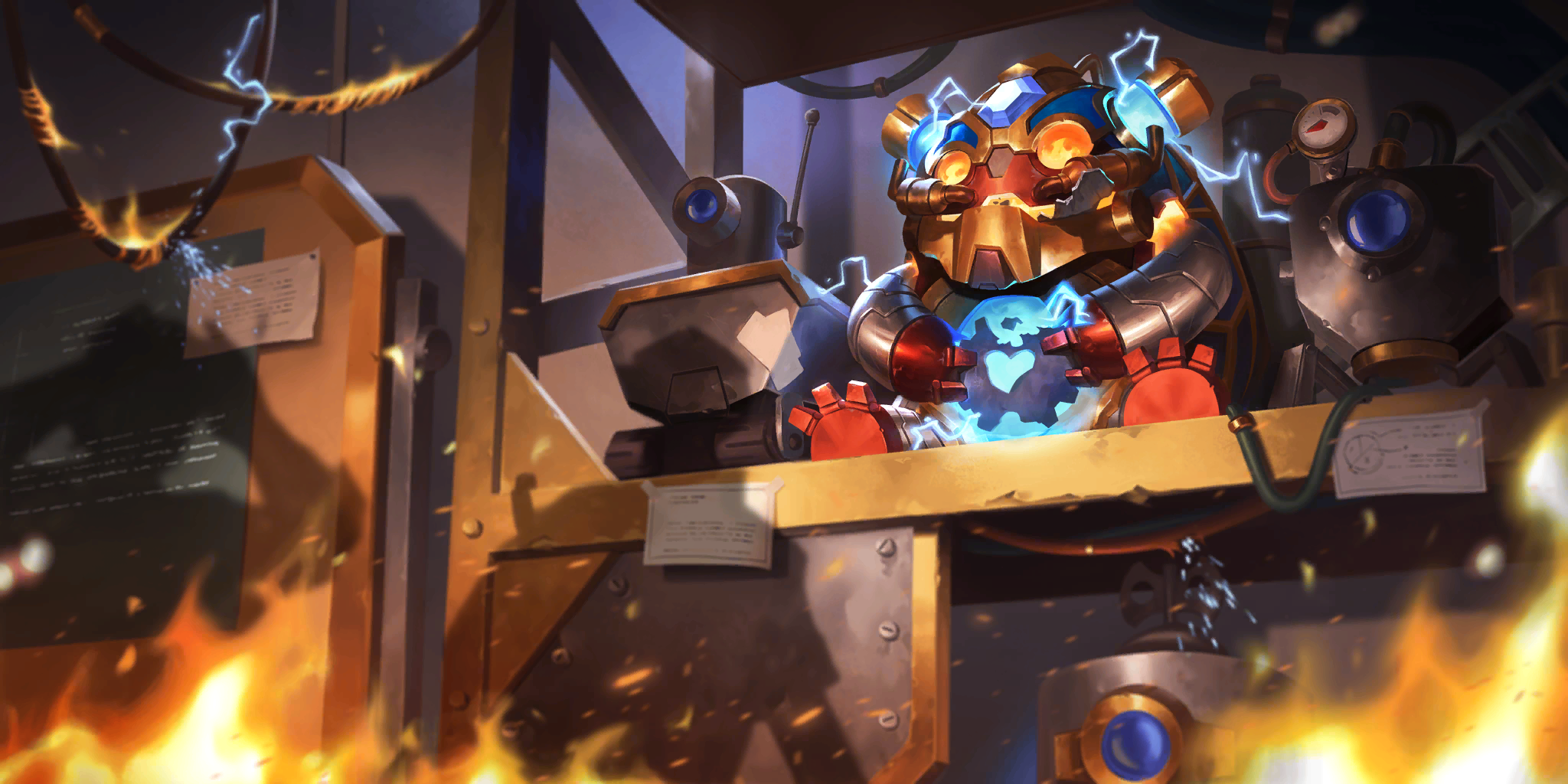
Acorn, the Hextechnician gets the cleanest version of it: “You wouldn’t find his name on any of the blueprints, or credited in any of the songs, but those in the know agreed: Acorn was the heart of the whole operation.” He costs one mana.
Amateur Aeronaut is the joke with the knife in it. A Piltovan engineer says: “Personal flying machines? A pipe dream! I just had my apprentice throw the latest prototype out, in fact. Now, where is he?” On Prototype Porobot, it is the apprentice who is doing the explaining while the lab burns. And Eager Apprentice carries the city’s line about who does not make it: “Not everyone is cut out to further progress in Piltover immediately. Some need a little guidance, those who look at invention through the wrong lens, for instance.”
Which brings this back to Axel and his documentation, because Piltover has a record of what happens to paperwork about people the city would rather not discuss.

“Let them say what they will about my methods. They cannot deny progress, the light of my knowledge is shining like a beacon through the darkness of ignorance!”Viktor, flavor text on Hexcore Foundry (03PZ020)
Viktor’s biography is written in the voice of a chronicler trying to research him, and the first thing that chronicler hits is a filing problem.
“Your humble author has made several requests to the Piltover Council and various faculties within the Academy, but they claim that any records relating to his employment there were lost during the tumultuous events that ultimately led to his death. I will leave it to your judgment as to whether this seems plausible.”
“This is precisely why I find it difficult to believe that no records have survived in their administrative archives, not to mention Heimerdinger himself, who some on the Council claim not even to remember! Such petty revisionism!”
Viktor’s biography, RuneGrove
The same chronicler notes that he had to source “what little remains of the hexgate construction documentation” by, in his words, less official means. Our Piltover Council entry records the episode as a matter of fact: its authority over hextech is closely guarded, and both the Council and its faculties said the documents were gone.
Axel is waiting on the documentation. The institution that keeps the documentation has already misplaced a full employment record for one of the two men who invented the technology.
The Clans Pay the Wardens, and a Blueprint Can Be Taken Out of Circulation
Donations that arrive as bespoke hextech, a caliver locked away, gauntlets that wreck the wearer, and one apprentice who kept his name.
There is one more term in the contract, and it is the one that would decide how a Piltover zone actually plays. The clans fund the police. Our Piltover Police Department entry and the gallery agree on the mechanism.
“The organization is funded by trade taxes and ‘voluntary’ contributions from the mercantile clans, outfitting the Wardens with uniforms and equipment. Many of these donations take the form of unique hextech, such as specialized weaponry or other devices.”Riot’s Piltover gallery, Wardens

Riot put the scare quotes on “voluntary” itself. And when Albus Ferros dies on the board, his last word is not a regret about the work. It is “Enforcers!”
A house that arms the law can also bury a design. Vishlaa's Hexlyene Caliver was “originally manufactured for the Piltover Wardens,” and the gallery finishes the entry like a case file: “the designs for this hex-powered weapon have since been locked away as being too dangerous.” Somebody made that call, and the maker’s name is still on the object.


The Atlas Gauntlets entry is the other side of that ledger: “exceedingly rare and powerful hextech augments that considerably boost the wearer’s strength and dexterity. Continued usage has resulted in skeletal damage to the wearer, but this has not halted demand for such items.” The product breaks the person using it and the order book stays full.

And then there is Vaido Violante, who is the exception worth naming: “a former apprentice of Corvin Reveck, Vaido works on numerous projects at once, but stabilizing the energy outputs of his renowned Atlas Gauntlets is at the top of his list of priorities.” He came up through an apprenticeship, the gauntlets are described as his, and he is still trying to fix the thing that wrecks people’s bones. That is what the top of this ladder looks like when it works. It is a real destination, and exactly one person in the gallery has reached it.
A Crafting Line Where the Recipe Is Public and the Rights Are Not
Grounded speculation on the profession this canon already describes, and the parts Riot has never said anything about.
None of this is a plan. Riot has never described a profession, a crafting system, or a Piltover zone for the MMO, and the only thing confirmed about the game is that it is set in Runeterra. What follows is a read of the canon, not a report.
Take the read on its own terms, though, and hextech is the most game-ready craft in the setting for a reason that has nothing to do with gadgets. Riot removed the talent gate from it and then spent a decade writing who controls the substitute. That is a progression system with a villain already cast.
What canon says: Jayce’s biography calls him “the youngest apprenta to ever be offered patronage by Clan Giopara.” Apprenta is the entry grade, and the promotion out of it is an offer, not an exam. The Eager Apprentice card is blunt that some people never get one.
What a game would have to model: a starting tier where the blocker is access rather than skill points. You can learn the craft. Getting a bench is a separate problem.
What canon says: Jayce prices delivery at funding plus a good forge, run by a chief who knows the work. Hextech does not stabilise on the first try, and each artifact is “a bespoke creation that will likely have taken years to craft.”
What a game would have to model: failure as the default state, and a shop as shared infrastructure rather than a personal crafting station. The Forge Of Tomorrow destroys itself to ship one invention, which is a costed workshop if it is anything.
What canon says: the crystals are a monopoly held by Clan Ferros, and the rights to sponsor a project go to auction. Two rival clans bid for Jayce’s Hexgate research and lost. Every clan sigil marks the inventions the house owns.
What a game would have to model: the interesting progression is the contract, not the recipe. Which house backs you, what the terms are, and whose mark ends up on the object.
What canon says: the patron’s assets appreciate off the researcher’s output. Ferros’ Dividend grows with every six-plus cost spell played, the Skycruiser carries his name, and a design can be locked away as too dangerous.
What a game would have to model: an output that is only partly yours, and a house that can withdraw a blueprint. Confiscation is a mechanic Riot already wrote a card’s worth of fiction for.
A skill tree cannot hold that. A skill tree says the ceiling is your own effort, which is the exact claim Piltover’s own encyclopedia entries decline to make. The canon-true version is a contract: pick a house, take the crystals and the forge and the crew, and hand over the sigil rights. The interesting choices are all in the terms.
It also gives a Piltover zone something most crafting zones lack, which is somebody to be angry at. Every hex crystal holds a Brackern. Every clan-funded Warden was armed by a donation. Every blueprint can be recalled. And somewhere on the shop floor there is a man who was told he would be listed as co-inventor once the documentation was done.
Riot has not said any of this is coming. Riot has already written all of it down.
Would You Take the Ferros Contract?
The forge, the crystals and the crew, in exchange for whose name goes on the finished thing.
A Piltovan clan offers to fund your forge, your crystals and your crew. The patents, the sigil and the airship carry their name. Do you sign?
Read Next
Three more reads on what Runeterra’s own systems imply about the game Riot has not shown.


Nothing here is confirmed. Sources are Riot’s own canon as held in our database: the Legends of Runeterra card text and recorded voice lines for set five’s Piltover run, the Piltover region gallery, and the biographies of Jayce, Viktor and Camille. A RuneGrove lore read.


