
Every League champion ships with a home region stamped on the card. Nilah’s says Bilgewater. Read her actual story and that stamp starts to look like a mailing address she picked up last week.
 Nilah is a monster-hunter who wandered into the port chasing bigger prey. Her real home is a kingdom called Kathkan, a place our canon names in plain text and the map has never once drawn. For a game that has to decide which corners of Runeterra to build first, that gap is the whole story.
Nilah, the Joy Unbound
Zone read
"Bliss in life, and bliss for ever after."
The Warrior Bilgewater Only Borrowed
Her biography is blunt about it. She is not a local who grew up gutting fish on the piers.
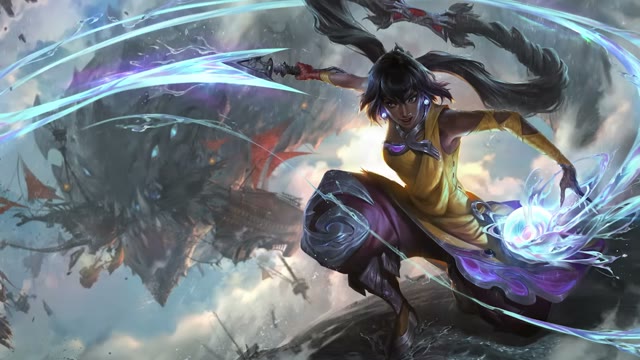
A confident and joyful woman who always wears an eerie smile, Nilah’s sudden arrival in Bilgewater has sent the city into an uproar. Her duels with rampaging sea serpents defy the limits of human ability.
From Nilah’s biography
She arrived. She is not from here. Bilgewater is a stage she picked because it has the most monsters per square mile of anywhere she could reach, and any threat taller than a house pulls her into a fight. The city is a hunting ground, not a birthplace.
Riot leaned all the way into that in her champion theme, which is less a plotted trailer than a music-and-art piece. It is worth watching for one reason: you can see how much of this character and this port the team had already designed down to the pilings.


Those middle plates are the tell. Before Nilah had a single line of dialogue, someone had already drawn the harbor she would fight in.
Kathkan, and the Dead Empire Next Door
Here is the part that never makes it onto the champion select screen. Nilah was not always Nilah.
The precocious child of a large Kathkani family, the girl who would become Nilah was not a warrior at all, rather, she was a lanky bookworm with an interest in myths and legends. Kathkan had known relative peace since its neighbor Camavor’s collapse almost a thousand years prior.
From Nilah’s biography
Two proper nouns in one breath, and neither of them is on the map. Kathkan is her homeland. Camavor is the empire next door, the same fallen Camavor whose mad king Viego drowned in grief and became the Ruined King. Nilah grew up in its long shadow, reading about the age of heroes that ended when it fell.
That is a lot of settled world for a place with no coordinates. An MMO does not have to invent Kathkan from nothing. It has a founding neighbor, a thousand-year timeline, a literary culture, and a ruined superpower on its border, all already written. What it does not have is a single painted vista. It is the definition of an expansion region: real enough to sell, unbuilt enough to save.
We laid out the case for which regions are launch-shaped and which are expansion-shaped in our deep dive on zone predictions. Kathkan files hard under the second column.
The Prison Under the Capital
The reason a lanky bookworm became a demon-powered monster slayer is the most MMO-shaped thing in her whole file. Her favorite childhood story was real.
It spoke of the fantastical Lord of Joy, Ashlesh: A many-limbed beast who menaced the world along with its nine ferocious siblings. Hungering for primal joy, Ashlesh attempted to consume the realm of the gods, but the gods struck the monster down, trapping it deep below the earth in an endless, shimmering lake within the seventh layer of the underworld. There it would be guarded by a mythical order of heroes.
From Nilah’s biography
The order guarding that lake, she worked out, was beneath her very feet in the heart of the Kathkani capital. She went looking for it, vanished for ten years, and every trace of the girl she used to be was scrubbed from the world while she was gone. The woman who walked back out carried the demon’s power and a smile she cannot switch off.
Sit with what that description actually gives a designer. A capital city. A hidden order with a job title. A prison-lake in the seventh layer of the underworld. A caged god and its nine siblings. That is not a blank region waiting for content. That is a zone with its endgame dungeon and its resident faction already sketched in prose, sitting in a country nobody has drawn. Her leveled Runeterra card even signs the address: she calls herself Nilah of the Seventh Layer.
What a Demon Is in This World
To understand what Nilah is carrying, and what an MMO built on this canon stocks its raids with, you have to know what a demon actually is here. Our encyclopedia is specific about it.
Demons are among the oldest and most feared entities in Runeterra, spiritual beings that predate most mortal civilizations. Where ordinary spirits may be benign or neutral, demons are fundamentally parasitic: they sustain themselves by provoking and consuming mortal suffering. Each demon is attuned to a single negative emotion or primal fear.
From the Demon race entry
The bestiary entry adds the cruel mechanic: a demon has no shape of its own, it takes form only through the darker feelings that stir within mortal minds, and once it settles on a victim it maligns and manipulates the person, corrupting and misleading them to deepen their distress so it can feed. Ashlesh is the outlier that fed on joy instead of dread, which is exactly why the woman who came back is possessed of a strange smile and an unending, ceaseless joy.
Legends of Runeterra turned demons like these four into cards, and every one of them is a raid encounter in miniature.


Camphor, the Doubt is the template: a demon that steals the very strengths that define you before it feeds on your despair. Blinded Mystic and Saga Seeker are the mortals who fought back, an oracle who outlasted the thing that blinded her and a dying man who chose to drag it into the grave with him. And Steem is the closest parallel to Nilah herself.
After finally overpowering Steem, Evelynn chose then not to destroy the lesser demon, but to bind him to her forever.
Flavor text, Steem
Beat the demon, keep the demon. That is the deal her biography all but spells out for Nilah and Ashlesh, the ending it leaves deliberately unconfirmed, and it is the deal a whole region of these things could offer a player. Kathkan’s prison-lake is not a one-boss zone. It is a shelf of them.
Why the Coast Gets Built First
So if Kathkan is the payoff, why would Nilah still put Bilgewater on the launch map? Because the port is the easiest region in Runeterra to hand a monster-hunter, and it is the one Riot has already finished painting.
It is unknown whether the sea monsters around Bilgewater inspired the beliefs in the Mother Serpent, or vice versa, nonetheless leviathans have become a staple in Bilgewater’s varied cultures.
Bilgewater gallery: Monsters of the Deep

A region whose culture is built on hunting things bigger than ships is a region built for her. The bay itself sets the tone.
Surrounded by treacherous straits and towering cliffs, Bilgewater Bay is as dangerous as those who call it home.
Bilgewater gallery: Bilgewater Bay

And it is not one island. It opens straight onto more water and more prey, which is how you get the seams for later zones without leaving the launch region.
While much of Valoran knows the archipelago as the Blue Flame Isles, to the indigenous people of Buhru they have only ever been the Serpent Isles.
Bilgewater gallery: The Serpent Isles

There is more of it than any two zones need. A quick pull from our Bilgewater gallery, all official art, all one click deep:


The other reason Bilgewater works as a first zone is that it teaches the loop Nilah is built to run. Her own Runeterra cards spell it out: she does not settle anywhere.
In the north, a new challenger awaits Nilah and her monster-hunting crew: a creature called the Volibear, who threatens to destroy the Freljord that once worshipped him. For Nilah, the chance to test her skills against a monster others call a god is the opportunity of a lifetime.
Flavor text, Nilah



Start on the coast, take a bounty, sail north to fight a god-bear, come back richer. That is the between-zone travel fantasy of an MMO, written into a champion’s card years before the servers exist. You launch where that loop already has a home.
Launch Coast, Expansion Interior
Put it together and Nilah stops being a class hint and starts being a scheduling hint. She stands in the region you build first and points at the region you build later.
Bilgewater is the region Riot has drawn to death. Our own archive holds more than two dozen painted gallery plates of it, from the slaughter docks to the Buhru temples. It sits in the middle of the sea lanes, it connects by water to almost everywhere, and it runs on a loop, take a bounty, hunt a monster, get paid, that is already an MMO gameplay loop. If you have to ship one coast on day one, this is the safe one.
Kathkan is the opposite kind of pick. It is named in canon and drawn nowhere. It sits beside Camavor, the ruined empire whose fall Nilah grew up reading about, and it hides a demon-prison and a secret order under its capital. That is a payoff you hold back. You do not open your MMO on the mystery region; you sell it two years later as the expansion that finally puts Nilah’s homeland on the map.
None of this is a plan anyone at Riot has confirmed. It is a read, drawn from a champion who happens to have one foot in a finished port and one foot in a country that only exists on paper.
Cast Your Vote
Should the Riot MMO open on Bilgewater’s coast and hold Kathkan back for an expansion?
None of this is confirmed. Nilah’s card says Bilgewater, her story says Kathkan, and the map says neither of those interiors exists yet. Every canon commitment like hers is one more corner of Runeterra an MMO could inherit. Sources: Nilah’s biography, the Demon encyclopedia, and Legends of Runeterra flavor text, all on RuneGrove. Analysis by RuneGrove.


