

A Woman Stops at the Mouth of a Caldera and Counts the Cost
Ahri crosses into the Garden of Forgetting already knowing the legend about who walks back out.
She has heard about this place since she was a child, and what she has heard is not a rumour of healing. It is a warning about arithmetic.  Ahri has crossed the southern caverns of Ionia to reach a garden that is known, in the stories Ionians tell each other, for what it keeps.
According to the stories, those who stepped over the threshold of the garden began as one person and left as someone else entirely, or did not leave at all.
Source: Garden of Forgetting (short story)
She steps over it anyway. That decision, and the price attached to it, is the most complete piece of quest design sitting unused in Runeterra canon. The Garden of Forgetting is the rare Runeterra location written as a transaction rather than a landmark. It will take your pain. The fee is the memory the pain is attached to, and the fee is not refundable.
Read the canon around it and a pattern falls out: every named figure in this grove is defined by what they paid, what they refused to pay, or what they are still paying. That is not a setting. That is a quest chain with a hook, an escort, a reveal, and a finale, and Riot has already written all four.

Magic suffuses every part of Ionia—its people, its history, and most of all the land itself. All aspects of life there hang in a balance, with still so much left to be discovered and explored.
Source: Ionia: The First Lands
Our own encyclopedia puts the door in a specific spot. The grove sits in the southern reaches of Ionia’s Navori province, and its entrance lies where stone gives way to soil and narrow, labyrinthine caves open to the sky inside a deep caldera. An MMO would not have to invent the approach. It would have to decide who is standing at it.
The Fee Is Collected by an Old Woman With a Pair of Shears
The Gardener cuts the flower off Ahri’s face, then explains exactly what the exchange costs before she sells it.
The first thing that happens to Ahri inside is that a snow lily reaches for her face, and she leans into it. The second thing is that the flower falls to the soil, cut at the stem, because someone was already standing behind her. The gardener does not introduce herself. She explains the local economy.
“The flowers want something from us,” she said. “Just as we seek something from them. It would be wise to keep your nose to yourself. I would know. I have to feed these hungry babies myself.”
Source: Garden of Forgetting (short story)
Ahri calls her Ighilya, great grandmother, out of respect for what she can do. The stories call her the Eater of Secrets, the Forgotten, and the Witch Gardener. She is a quest giver and a vendor in the same body, and she prices the goods honestly, which is rarer in games than it sounds. Before she sells, she tells the buyer what the purchase does.
“You will be broken,” said the old woman. “You will never again be one.”
Source: Garden of Forgetting (short story)
Then she gives the instructions, and they read like a tooltip. Give your breath to the flower while you think on the memories you want to be rid of. The flower will consume them. Do not inhale again until you feel nothing.

The people of Ionia’s many provinces have always seen themselves as part of the natural world, and adapted their ways to live alongside all manner of fantastical flora and fauna.
Source: Ionia: Life As One
Everywhere else in Ionia that relationship is a philosophy. Here it is a contract, and only one party can sign. The Gardener says so in the sentence that governs everything else in this article.
This garden will not refuse a gift freely given, for it always hungers.
— The Gardener, Garden of Forgetting, read the story
A garden that always hungers has to be fed on a schedule. Which is where the staff come in.
The Staff Settle the Bill Every Night, and One of Them Is Losing the Thread
Ophelis Gardener’s card says the caretakers give up memories nightly. Her dialogue with Lillia shows it landing.
Legends of Runeterra built this grove out properly, and the card that matters most is a common. Ophelis Gardener does one thing in play: it fully heals an ally, then puts that ally to sleep. The heal and the sleep arrive together and cannot be separated, which is the garden’s whole business model rendered as a two-clause rules box. The flavour text underneath says what the job costs.
To care for the Dreaming Tree and the surrounding garden is a high honor, but one that requires sacrifice. In a ritual of respect and appreciation, the garden’s caretakers offer up their own memories, losing a part of themselves every night.
Source: Ophelis Gardener (09IO046)
Every night. Not once, at a shrine, for a cause. The people who keep this place running are on a recurring subscription paid in themselves, and the game gives one of them a name. Lillia, Sprite Mother and Mister Root all call her Aisha.
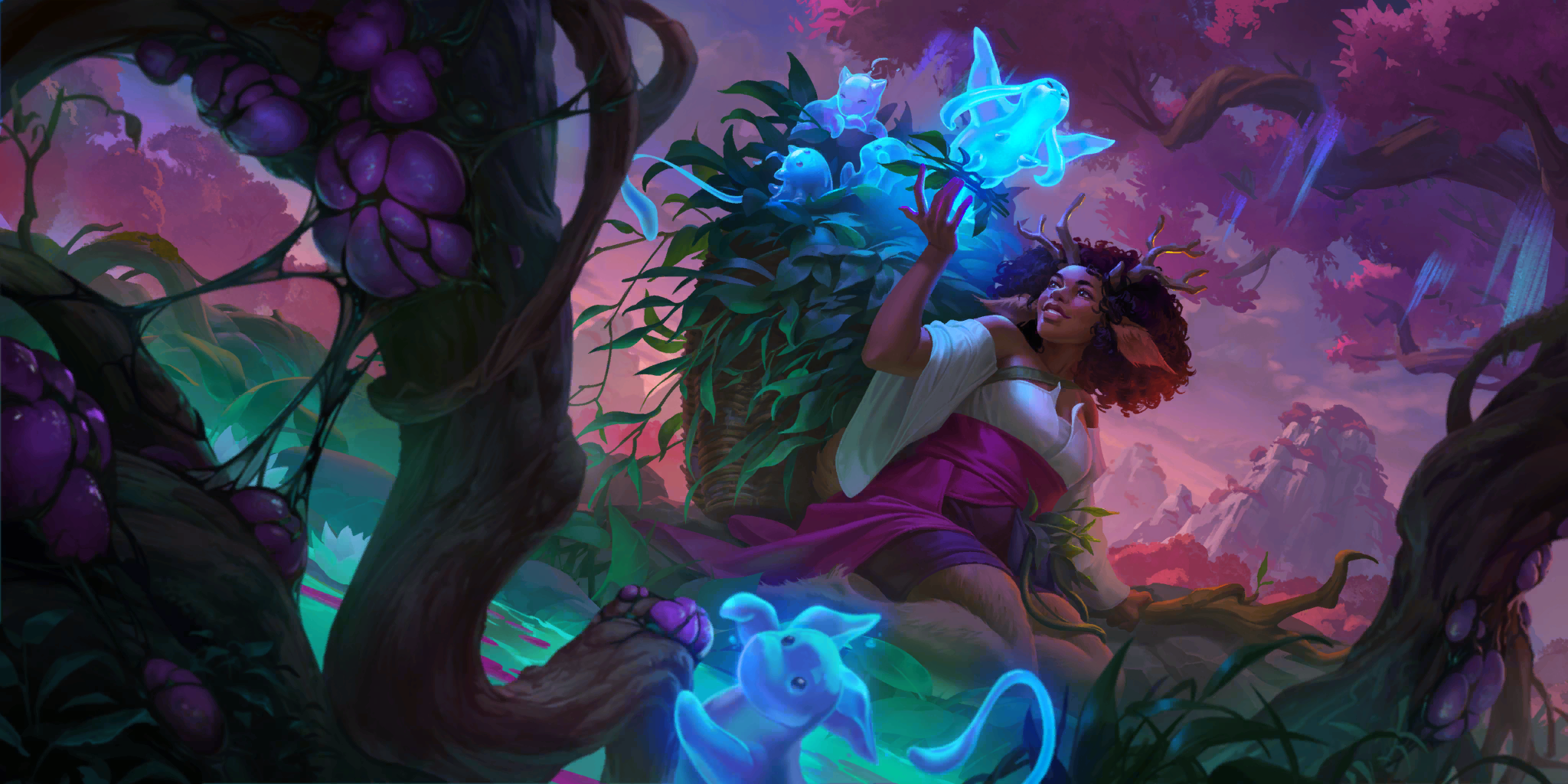
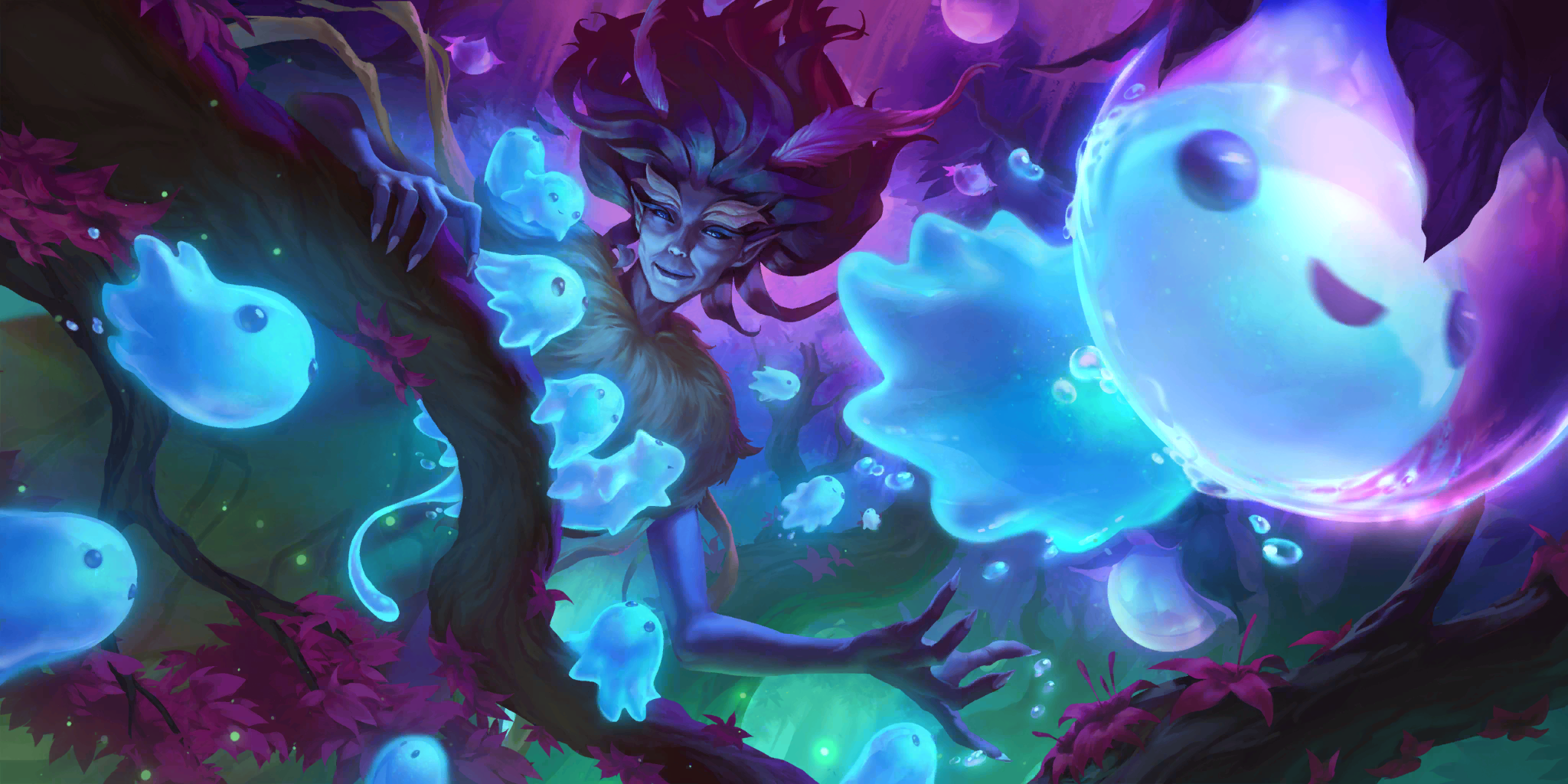

Here is what that looks like in dialogue, which is the part a quest designer should read twice. Aisha is not dramatic about it. She loses a sentence halfway through saying it, and the conversation simply moves on.
Legends of Runeterra: Lillia and the caretaker, on the same board
Lillia: “Aisha! The garden is greener every day.”
Ophelis Gardener: “But I needed to tell you... I can’t remember.”
Legends of Runeterra: both of them notice the tree changing
Lillia: “Mother Tree’s leaves rustle and whisper.”
Ophelis Gardener: “To me as well. Something is not right.”
Legends of Runeterra: Mister Root asks the caretaker what the ritual leaves behind
Mister Root: “Don’t you ever feel hollow inside?”
Ophelis Gardener: “Only on weeding days.”
Legends of Runeterra: Mister Root wishes for the thing the garden sells
Mister Root: “I wish I could forget it all.”
Ophelis Gardener: “Perhaps then you would forget to mope too.”
Official Legends of Runeterra voice lines, quoted verbatim from our own voice-line archive.
Mister Root supplies the other half of that exchange, and he is not being funny. His card reads “Wow, one day all of this beauty will be dead, and so will we. I hope I’m first. Hehe!” He asks Aisha whether growing up hurts, and she tells him it does, but that staying the same hurts more. This is a hub full of NPCs who have all made the same calculation and are living inside the result.
Which is why the one caretaker who cannot pay the toll is the interesting one.
The One Caretaker With Nothing the Flowers Can Take
Lillia was grown from an unbloomed dream of the tree, so the ritual cannot touch her. Her own power does its work anyway.
 Lillia was not recruited into this garden. She was produced by it. Her biography says she began as one of the Dreaming Tree’s own dreams, captured in a bud that fell to the ground before it could bloom, and the biography is careful to note that this had never happened before.
Sprouting into an awkward fawn creature with the flower bud still on her head, Lillia’s only company was her mother tree, and the dreams that drifted to the garden each night.
Source: Lillia’s biography
Our encyclopedia files her kind as a spirit-kind native to Ionia. The Fae Fawn entry says they descend from the great spirit trees and are tied most closely to the Garden of Forgetting and its Dreaming Tree, and that through Lillia the Fae Fawn are shown as caretakers of the sleeping mind. She has no past outside the grove, so there is nothing the flowers can take off her. The ritual has no purchase on the only staff member who was grown on site.

Riot gave her a card reveal in Legends of Runeterra that is mostly her voice, and the voice is doing the job the garden does. “Sing to me of little lost dreams far away.” “You won’t harm the dreams, not a one.” It closes on “sleep quietly, dream well.” Our page for that video is here.
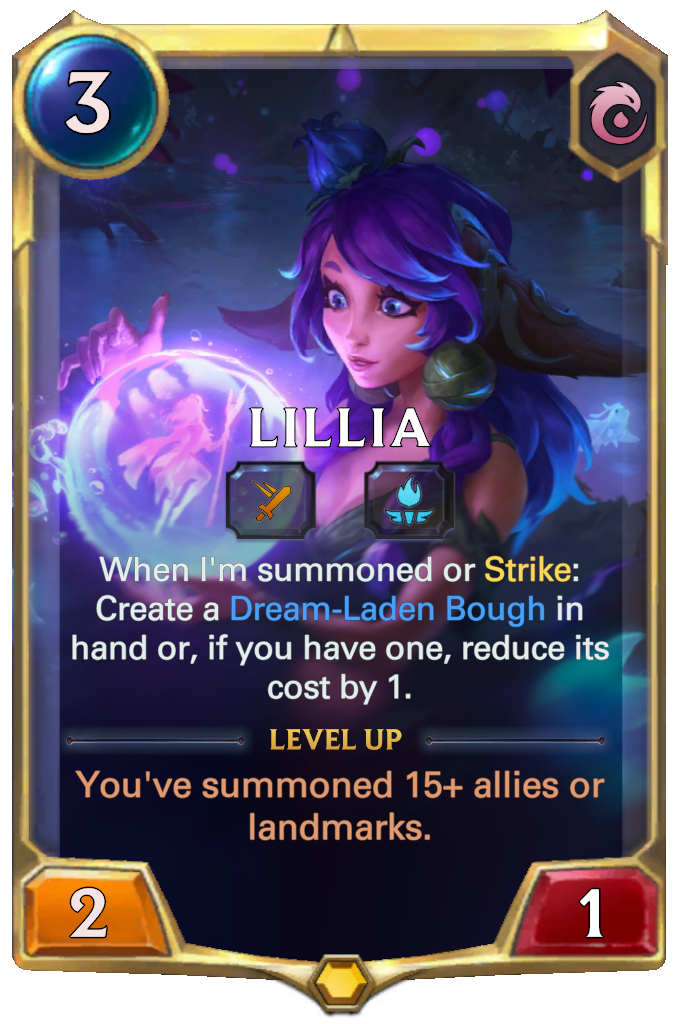

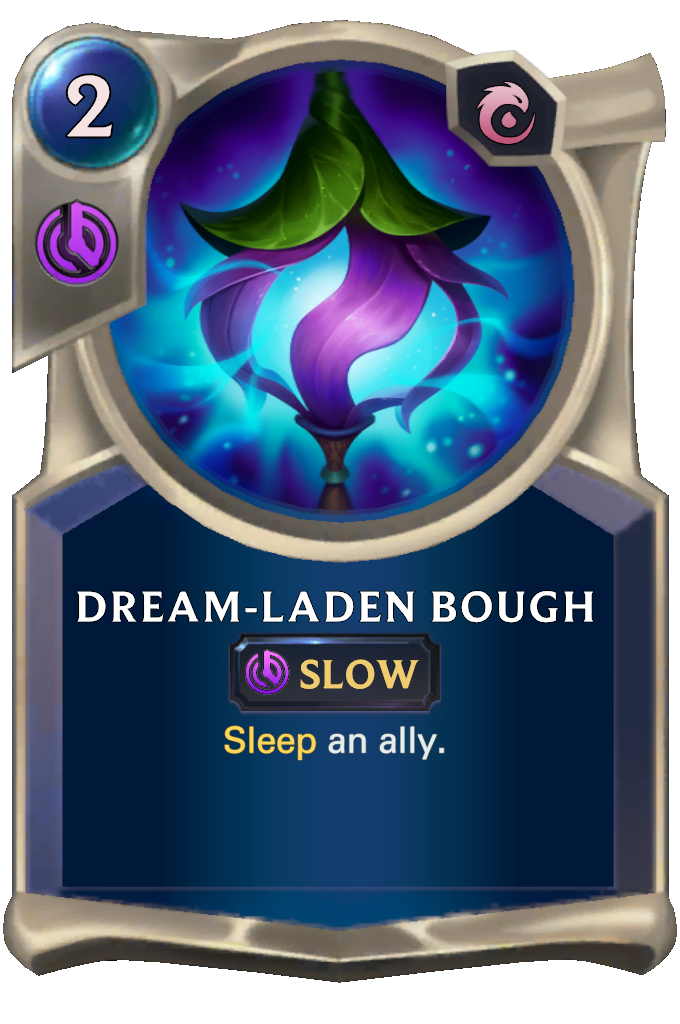
 P Dream-Laden Bough
The branch she carries out of the garden. In League it is a damage-over-time mark; in her canon it is the container she ferries other people’s dreams home in.
 R Lilting Lullaby
Everyone marked by her goes drowsy, then asleep, and takes extra damage when something wakes them. Her ultimate is the garden’s transaction with the serial numbers left on.
Now the part of her story that nobody in the canon calls a problem. War pushed into the grove, and one night warriors chased a lone figure all the way to the Dreaming Tree. A stray blade cut down the branch holding Lillia’s own unrealized dream. She panicked, and she did the only thing she knows how to do.
The humans awoke one by one, unable to remember what had brought them to the forest, or what they had done.
Source: Lillia’s biography
The hunted figure got no justice out of that night. The hunters got an amnesty they never asked for and cannot refuse, handed to them by a frightened creature who thought she was being kind. Her mercy and the garden’s fee do the same thing to a person, and neither one asks first. She says the quiet part herself in her League voice lines, with no idea it is the quiet part: “The humans forget so much when they awake.”
Her mercy and the garden’s fee do the same thing to a person, and neither one asks first.
She is not the exception to this place. She is its purest expression, running without a price list. And she is not the first thing here to be forgiven by force.
The Grove This One Grew Out of Was Killed by a Man Who Got the Same Deal for Free
Ivern felled the God-Willow, was remade by it, and had his own violence reduced to an echo. Then he raised its seed.
The Dreaming Tree is a survivor. Its seed came from the God-Willow, which stood over Omikayalan, a sacred grove held holy by all Ionians and known as the Heart of the World. In ancient times, Omikayalan was destroyed by war. Chimeric guardians, half human and half beast, died under its twisted branches trying to keep a raiding party off the tree. The raiding party got through.
Seeking to shatter their resolve, he took up his war axe, and roared with hatred as he struck at the God-Willow over and over again. The great tree fell.
Source: Ivern’s biography
What happened to  Ivern next is the reason this section exists. The life-energy released by the tree’s death undid him on the spot and rebuilt him as the Green Father. He wept, he asked for forgiveness, and then his biography records the settlement he received for it.
The violence and sadness of his former self were mere echoes in his heart.
Source: Ivern’s biography
That is the product Ahri walked into the caldera to buy. Ivern got it without asking, for the price of an atrocity. He then nurtured the seed cast loose in the God-Willow’s destruction, as he had many of Omikayalan’s descendants, until it took hold in what came to be called the Garden of Forgetting and grew into the Dreaming Tree. The garden that sells absolution was planted by a man who had already been handed it.
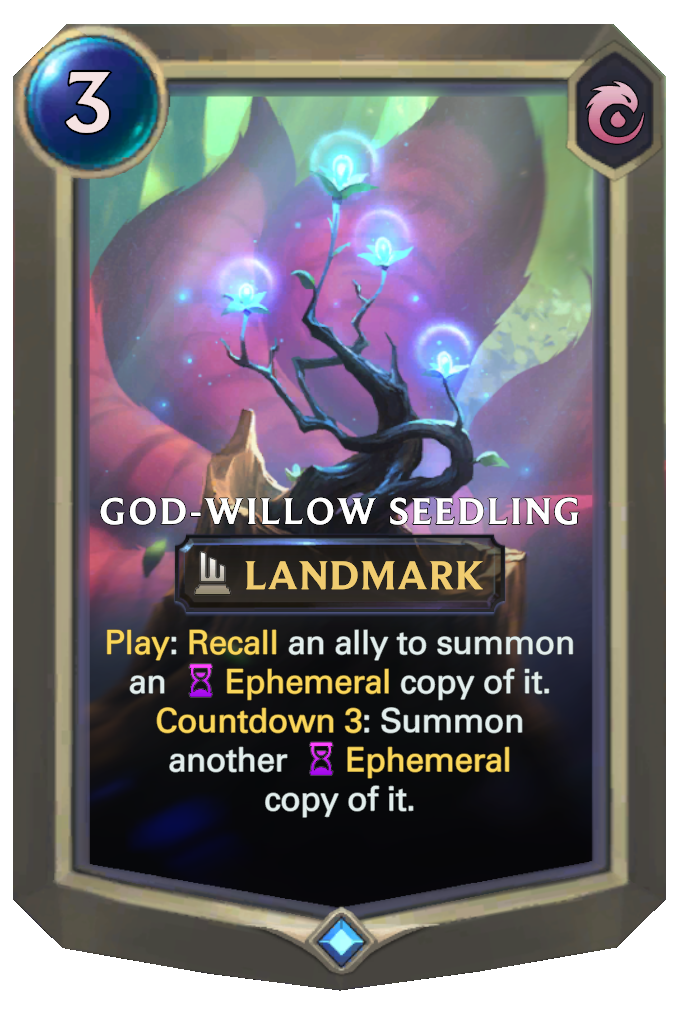
The seedling card puts it plainly. “Once, the God-Willow grew within Omikayalan. What springs forth from that place now may be stronger, may be weaker. What matters is that it is new.” New, in this grove, is a synonym for something that does not remember.
Ancient times
Ivern fells the God-Willow
The grove of Omikayalan is overrun and its guardians die defending the tree.
That same moment
The killer is unmade
Ivern the Cruel is undone by the life-energy and remade as the Green Father.
After the fall
A cast-loose seed roots
It takes hold in what came to be called the Garden of Forgetting, nurtured by Ivern.
Later
A bud falls unbloomed
Lillia sprouts from one of the tree’s own dreams, something that had never happened before.
The war
Fewer dreams arrive
War blazes through the land and the Dreaming Tree sickens with burls.
Now
Ahri at the threshold
A visitor walks in to sell a memory and stops halfway through the sale.

In the more remote mountain passes, the landscape is still littered with evidence of great wars from ages past—but instead of clearing the ruins, the Ionians choose to respect what remains, even if they no longer fully understand what it represents.
Source: Ionia: An Ancient And Respected History
A culture that refuses to clear rubble it cannot interpret is also running a grove whose entire function is clearing. Both things are true, they sit in the same region, and neither one is presented as hypocrisy. That contradiction is the best raw material an MMO writer could be handed.
Then the War Reached Navori and the Dewdrops Started Coming Up Wrong
With fewer dreams arriving, the tree grew burls, and the harvest at the garden’s heart began to turn.
The transaction depends on supply. The Dreaming Tree gathers dreams that drift in from the outside world, and for that to work, the outside world has to be sleeping well. Lillia’s biography records the moment the supply chain broke.
War blazed like a fire through the land, and in time, fewer dreams began to reach the garden. The tree itself grew sick, and became infected with burls—writhing tangles in its trunk, which oozed darkness.
Source: Lillia’s biography
The war in question has an address. The grove sits in Navori, and so does the Placidium, and Riot’s own region art explains why an invading army walked toward both of them.


Many have journeyed here to study at renowned schools, or meditate in its wild, magical gardens. Undoubtedly, this was why it became such a tempting target for the invading armies of Noxus.
Source: Ionia: The Placidium of Navori
But the cost of that day’s victory was immense, and some now question if fighting back was the right decision, since the harmonious balance of their homeland may have been lost forever.
Source: Ionia: The Great Stand
A region that is publicly unsure whether its own victory was worth the price, feeding a garden that runs on people who are certain theirs was. The grove is already showing what happens when the trade goes bad.
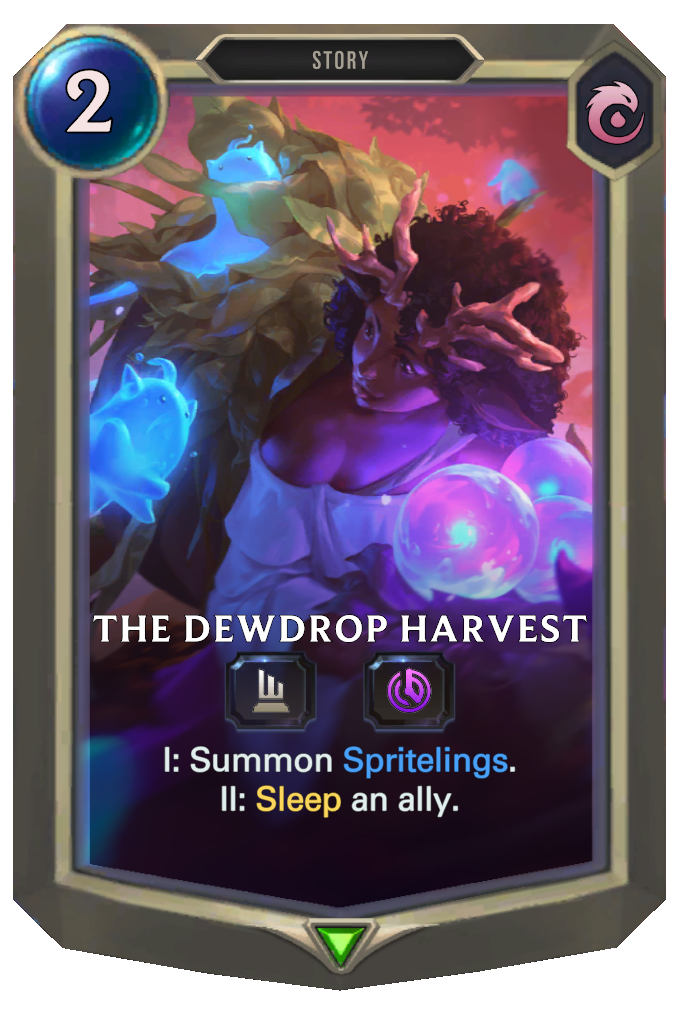
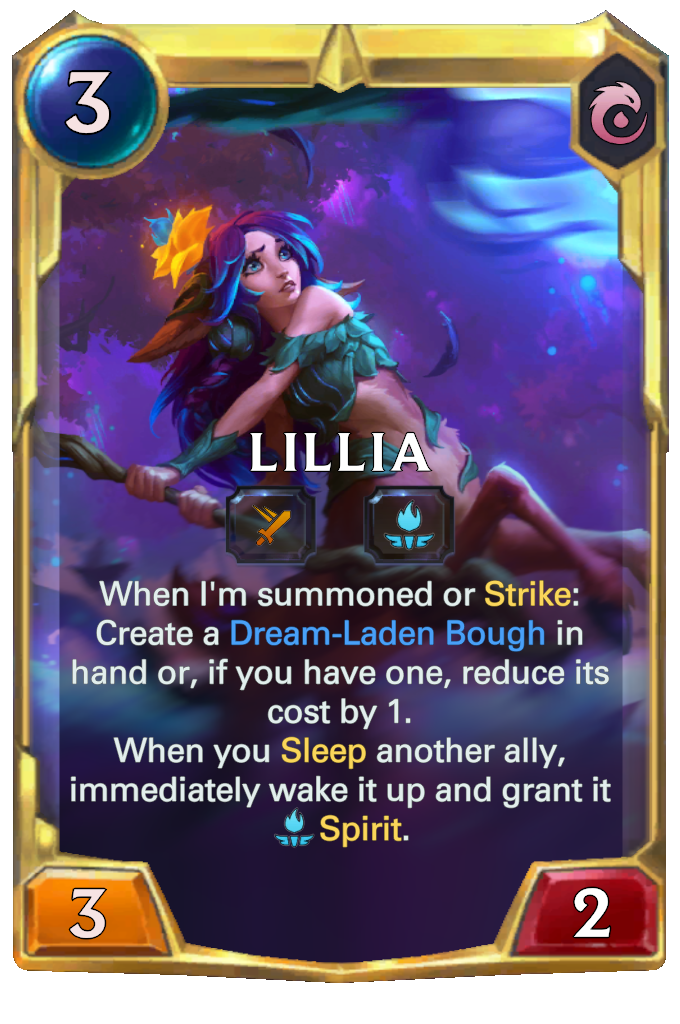

Her own card text tracks the decay in real time. At the heart of the Garden of Forgetting the dewdrop harvest grows near, tended by Lillia and the other caretakers, and a strange corruption can now be seen inside the drops, with the dreams they show turning haunted and dark. Level her up and the sentence finishes itself: a twisted corruption has taken root, threatening to leave dreamers stranded in their own dangerous nightmares.
So she leaves. Not to heal the tree, which she cannot do, but to go and fetch. Her first line on the Rift is a status report and a mission statement at once: “The garden is filled with burls. The burls, with nightmares... Mother Tree, I’ll remind them how to dream.” Another has her calling out for the ones that never arrived. “Where are you, little lost dreams? I’ll bring you to your home in the Dreaming Tree.”
Ahri Stopped Breathing Halfway Through the Sale
Three memories in, the fourth caught in her throat and she broke the spell rather than lose it. The first three stayed sold.
She paid. That is the part people skip. She breathed into the lily and watched a lake go, and the day he painted a flower down her spine, and the moment she stood in the water holding his body. Each one dissolved and each one hurt less than the last, which was the point.
Then the fourth memory came up. A stone cavern, a woodcutter she had just drained, and the raven-haired man standing there, having watched her do it. She told him to leave, that she could not be good. He said he did not care, and that he was hers.
You are more beautiful than any flower.
Please leave me. My magic, I cannot control it.
I don’t care. I am yours.
I know. What am I? A monster.
I know. What am I? A monster.
— Ahri, Ruined King: A League of Legends Story, cutscene, the upload at 11:33
The memory caught in Ahri’s throat and she stopped breathing, breaking the flower’s spell.
No, she thought. I can’t lose this.
Source: Garden of Forgetting (short story)
The Gardener’s reaction is the design note. She does not congratulate a customer for buying well. She tells Ahri she did what many had not the strength to do, and names what everyone else in this grove chose: she did not succumb to peace.
Oblivion is worse. Much worse.
— Ahri, Garden of Forgetting, read the story
And then the receipt. Three memories are gone and stay gone. “You cannot take back what you gave, Iminha. The flowers do not relinquish what was freely given. But you may keep what remains.” On the way out the snow lilies turn on her, slash at her skin and bind her mouth, and she has to bite through them to reach the caverns. The last thing she hears is the Gardener calling after her that a piece of her lingers there always, and that unlike the two of them, the garden does not forget.
Both champions carry it afterwards, and Riot recorded the meeting.
League of Legends: the two of them, on meeting
Lillia: “Some come to the garden lost. Others, to lose themselves. Like you, Ahri.”
Ahri: “I am no longer lost, Lillia. Nor do I still want to forget.”
League of Legends: Ahri, on what the garden did not get
Ahri: “Not even cloud fruit could erase that memory.”
Ahri: “Memories are no longer mine to steal. They’re mine to make.”
Official League of Legends voice lines, quoted verbatim from our own voice-line archive.
Lillia recognises the customer type on sight, because she grew up watching who walks in. Ahri answers with the only line that closes this story. She is not lost, and she no longer wants what she came for.
What a Game Would Actually Have to Build Here
Riot shipped the garden as three staged landmarks, which is the nearest thing this canon has to a written quest chain.
Riot has already shipped this grove as three staged landmarks, each with numbered stages that tick over round by round. That is the closest thing in Runeterra canon to a written quest chain, and the order is not arbitrary.
The Dewdrop Harvest runs on a two-step countdown: summon the sprites, then put an ally to sleep. Its flavour text is the gathering brief. Each of Mother Tree’s dewdrops gives a glimpse into a dream happening somewhere in Runeterra, and each drop must be carefully harvested, nurtured, and protected. That is a collection objective with a fail state written into the verb list.
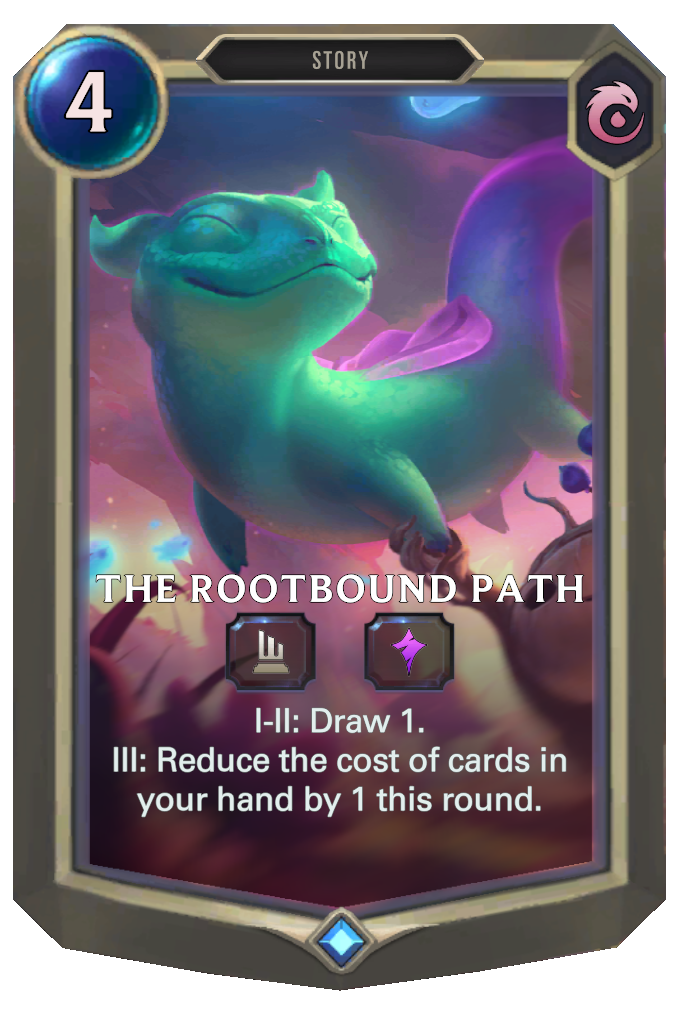
The Rootbound Path is the traversal step, and the flavour is a bestiary brief hiding in a common landmark: the Garden of Forgetting is home to a strange assortment of creatures both large and small, some with more sentience than they would like to have. In a grove that eats memory, a creature that wishes it were less aware is not a joke.
The Heart of the Tree is the destination, and it is the only one of the three that heals you. Dream sprites are one of the garden’s more plentiful inhabitants, and many of them will go on to enter dewdrops, guiding their dreamers towards their deepest wishes. Arrive, and the reward is that somebody else gets what they wanted.
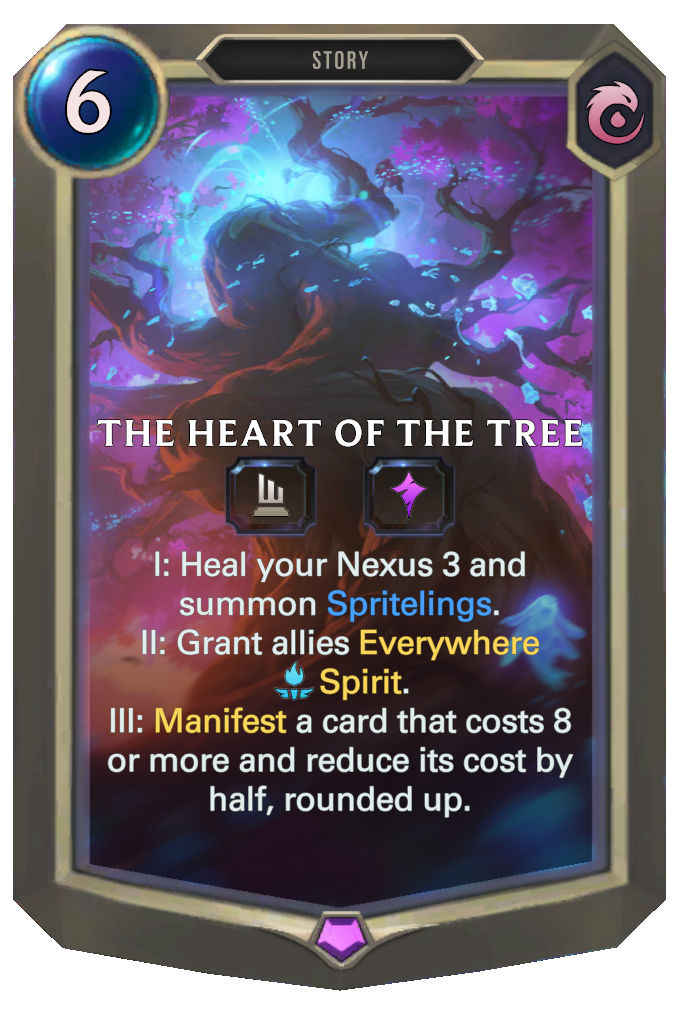
Lay the story beats over those stages and the chain assembles itself. The hook is not a quest board. It is an old woman at the mouth of a caldera asking what you came here to lose, and meaning it literally. The reveal is Aisha: you work with the caretakers for hours, and then you notice she has stopped finishing sentences, and the card text tells you why. The escort is a dewdrop that has to be walked home through country where the thing hunting it is a copy of itself.
The finale is the hard one, and it is the reason this is worth building. The vendor offers the trade, honestly, having warned you twice. Every reward loop in every MMO adds something to your character. This one subtracts, and the canon has already ruled that the subtraction is permanent, because the flowers do not relinquish what was freely given. Ahri completed this quest by refusing the reward at the last step, and she still left three memories behind.
None of this is announced. Riot has shown no zone, no quest structure, and no systems for the MMO, and this piece is a read of what already exists rather than a report on what is coming. But the raw material here is unusually finished for lore that no game has used yet: a location with a written entrance, a vendor with a written price list, staff with a written condition, a named customer who walked out mid-transaction, and a moral argument the region is already having with itself in its own gallery captions.
The question the grove asks a player is not whether they can beat it. It is what they would hand over to be rid of something, and whether they would want it back.
Would You Pay the Toll?
One question, one vote, and the results stay hidden until you answer.
If the Riot MMO put the Garden of Forgetting in the world, would you trade a memory to it?
Read Next
Three more reads of Runeterra canon for what it hands a game that has to build it.


Nothing here is confirmed. Sources: Lillia’s and Ivern’s biographies, the Garden of Forgetting short story, our Garden of Forgetting and Omikayalan encyclopedia entries, the Fae Fawn race entry, official Legends of Runeterra card text and voice lines, and Riot’s Ionia region gallery. A RuneGrove lore read.


