

Shurima Already Has a Mount Ladder, and Riot Wrote All of It
Most fantasy deserts are a texture. You cross them because the plot is on the other side. Shurima is not that. Somebody at Riot sat down and worked out how people in this specific place get from one waterhole to the next, and then drew it.
You can read the whole ladder off our own Shurima region entry and its gallery. It runs from a bad-tempered pack animal to a village that walks. Every rung has a cost, a hazard, and a social meaning attached, which is more design than most shipped MMOs manage for their whole mount tree.

Hardy beasts of burden common across Shurima, skallashi are ideally suited to the harsh desert environment. Notoriously bad-tempered, they are nevertheless treated with great reverence, their hides often painted with sacred symbols of protection, and their horns hung with totems and charms. To own one is often considered a sign of considerable prosperity.
Source: Shurima: Skallashi
Read that last line as a designer and it is a mount that doubles as a wealth check. The painted hide and the charms hung off the horns are transmog slots that already exist in canon. Bad-tempered gives you a handling quirk to build around.

Today, we began our journey to Nashramae! Samir is determined to cross the Great Sai before the next full moon, and is making SUCH a mess of things! I did not know a simple sandboard could collapse a whole dune. Neither did Sami. He's fine.
Zaifa's diary, flavor text on Rock Hopper
A sandboard is the cheap option, and the diary tells you its failure state: you can put a dune down on top of yourself. That is a traversal tool with a real downside, which is the hard part of mount design and Riot has already written it.

These massive creatures traverse the desert in cyclical patterns, feeding on the bugs and other small creatures most desert beasts ignore. Scavengers will often memorize the predictable paths these creatures take, and jump onto their backs to ride as far as they wish.
Source: Shurima: Sandswimmers
Nobody owns a sandswimmer. You learn its route, wait where it surfaces, and jump. It is public transit written as an animal, and the timetable is knowledge rather than gold.

Shurima's scavengers live by looting food, valuables, and trade goods. Mostly, they venture into the ruins of abandoned, sand-wrecked cities. Scavengers are prime targets for raiders when moving on foot, so will often ride sandswimmers to avoid ambush.
Source: Shurima: Scavengers
And there is the reason it exists. Riding is not a convenience here, it is how you stop being prey. Walking the same ground is what gets you robbed.

Some shurimans choose to live their nomadic existence atop giant, slow-moving creatures known as dormun. Protected by large chitinous plates, dormun evolved to survive the perpetual drought and harsh conditions of Shurima. The dormun-riders clean the creature and hunt any airborne pests who venture near, while the dormun uses unknown senses to located hidden reservoirs of water.
Source: Shurima: Atop the Dormun
Our bestiary entry for the dormun puts the deal plainly: Where the dormun goes, the village follows the sand roads to the new-flowing waters, settling wherever it can begin again.
So the settlement is not a dot on the map. It walks, it follows water, and it is steered by an animal that senses reservoirs nobody else can find. A hub that moves is a scary thing to build and a wonderful thing to play.

Dormun-riders use claw grips to traverse the complex series of ropes that connect the mobile village's dwellings. Once a rider becomes too old or infirm to “run the ropes”, they are lowered to the ground to live out the rest of their days as a land-dweller.
Source: Shurima: Dormun Riders
Claw grips on strung rope is a movement verb, not a decoration. It is the vertical layer of the village, and it comes with a social rule attached: lose the ability to run the ropes and you get lowered down to live as a land-dweller. Riot wrote an entire status system into a traversal skill.
The Roads Bite, and They Bite Differently Depending on Where You Are
A traversal system is only interesting if the space fights you. Shurima has three separate answers to that, and they are not interchangeable.


The raiders of Shurima survive not through trade, but through violence. These bands of marauders often attempt to blend into the environment in order to lure unsuspecting travelers into traps before killing them, taking their belongings, and (in very rare cases) eating them.
Source: Shurima: Raiders
The Shakkal are the version of that with a movement kit of their own:
These nomadic raiders are known for their agility, using hardened bone-braces and polearms to vault towards their victims at terrifying speeds.
Source: Shurima: The Shakkal
Ambushers who pole-vault at you are a mounted-combat problem, not a standing-fight problem. Bloodthirsty Marauder is the card version, and its flavor is a single grim line: The Sandthrashers do everything with their companions. Fight, hunt, kill... and eat.


This remote pass takes its name from the disorienting whistling that results when the wind blows hard enough through the hollow rock structures. Many unwary travelers have found themselves at the mercy of the deafened marauders who prowl the valley by night.
Source: Shurima: The Valley of the Song
A pass that goes loud enough to disorient you, patrolled at night by people the noise stopped bothering years ago. That is an audio-gated route with a day cycle on it, sitting in the Valley of Song on our atlas.
The shifting tides of the desert has been known to carve paths through bare rock, tumbling over the cliff faces in massive sandfalls. Traditionally, Shurimans toss beloved objects into the sands as gifts to the Ascended. As a result, such falls are often lucrative spots for treasure hunters.
Source: Shurima: Zoantha Cascade
The sand carves its own routes through rock and pours off the cliffs, and because people have been throwing offerings into it for centuries, the bottom of the fall is where the loot collects. Vertical traversal and a reason to go down it, in one paragraph. It is on the map as Zoantha Cascade.
Then there is the layer underneath everything. The xer'sai have honeycombed the desert with tunnels and hunt by feeling you walk. Xer'sai Hatchling spells out the pattern: Once a caravan has been disabled, the hunters will occasionally retreat and allow their hatchlings to forage forward. The big ones change the map outright, per Xer'sai Dunebreaker: only their dunebreakers have the mass and power needed to break through the veins of solid bedrock that snake through the Great Sai, and open up the lands beyond for further hunting.


Quicksand closes the loop between the two halves of this piece: In parts of the desert, old ruins have sunk into sand, creating hollows where unwary travelers might join them. The buried architecture is not only the destination. Sometimes it is the hazard you fall into on the way.
A Teenager Left a Travel Diary Across Six Cards
The most useful traversal document in Shurima is not a map. It is Zaifa, who is crossing the Great Sai toward Nashramae with a group of adults and writing down what goes wrong. Her diary is the flavor text on six separate Legends of Runeterra cards, and read in order it is a route log.
Day one
The sandboard incident
Samir wants to cross the Great Sai before the next full moon. A sandboard collapses a whole dune.
Night
Weather and tunnels
A storm from the west, xer'sai tunnels to the south, a temple to the north. They sleep inside the terracotta walls.
Lunch
Skallashi cheese
Kadira tugs a sleeping rockdoubb by the tail. They leave the cheese behind as an apology.
Later
A wall goes down
Kadira breaks a stone wall that was probably important to someone's ancestor. Zaifa is very cross.


We had trouble earlier! A great storm threatened from the west, and Taliyah passed xer'sai tunnels to the south. I spotted a temple to the north, and we are now safe inside its terracotta walls. The others are all asleep, and my flame, like me, is ebbing. I hope I dream well.
Zaifa's diary, flavor text on Sai Scout
Storm west, tunnels south, shelter north. That is a navigation decision written as a kid's journal entry, and it is the closest thing Runeterra has to a design doc for how you cross this desert: read the weather, read the ground, run for a ruin before dark.
Every Rung of That Ladder Stops at One Door
Now the part that makes the Tomb of the Emperors worth building a zone around. Nothing you ride goes in.
Our atlas entry describes it as a vast necropolis buried beneath the sands of Shurima's capital, and then adds the sentence that does the work: Its passages are guarded by traps and heaped with the treasures of the greatest empire Runeterra has ever known, and of the many raiders who have sought to plunder them, few have returned alive.
Passages. Not halls. The skallashi stays outside, the sandswimmer keeps to its route, the dormun cannot fit down a stair. You go in on foot, in the dark, with whatever you carried.
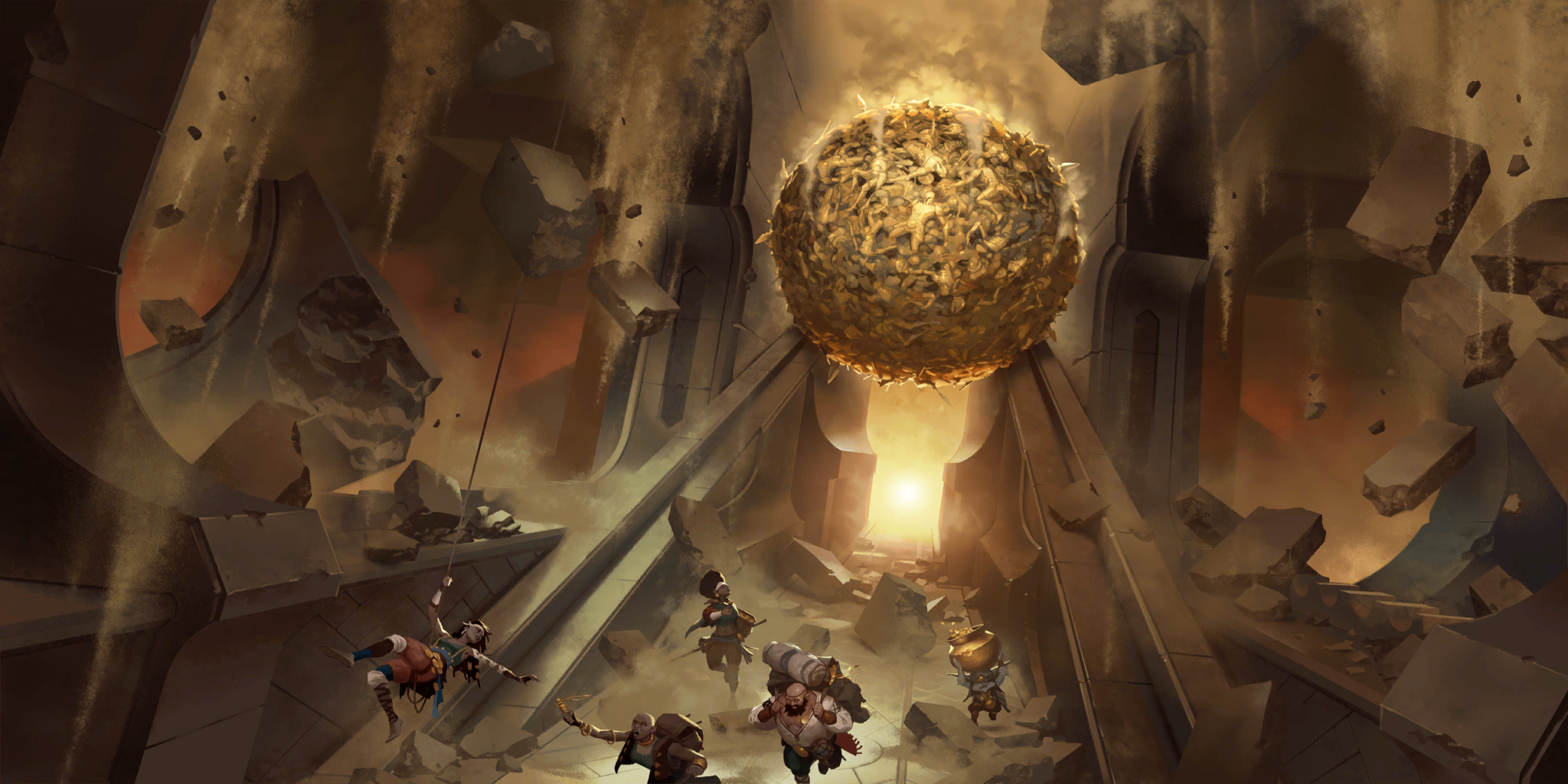


Buried Armory is Riot being funny about exactly this, and the joke only works because the trap is real:
“Why must you touch everything?”
“What, you think it's booby-trapped? You think some boulder's just gonna come rollin' outta–”
“RUNNN!”
– Argus and Silvio, tomb robbers
Flavor text on Buried Armory
Sarcophagus names what the room actually is: The Tomb of Emperors is no less lavish for serving as Xerath's prison. Indeed, the beauty of the place and its trappings is nothing if not a reminder of the inhabitants' fall from grace - a gilded prison.
And the getting-in problem has a canon answer that is not a lockpick. Our atlas entry says Sivir's ancestral crossblade, the Chalicar, is held to be the key to the tomb itself. An heirloom weapon that opens a dungeon is an attunement item with a story attached, and the story is that she pried it out of a sarcophagus in the first place. Her biography has her doing this work as a child:
They would brave cramped tunnels and forgotten crypts, hunting for anything of value, often scrapping viciously with one another over the best finds.
From Sivir - Biography
Profiteer shows you the other end of that economy, the guy back at the market selling what he claims came out of the tomb: “My friend, for you I've procured this incomparable beauty straight from the fabled Tomb of the Emperors and pulled it right from the hand of the great Renekton himself and as I rode out, I was surrounded by ten--twenty!--bloodthirsty sauren riders! Truly, a miracle that such a treasure has made it to your hands.”
A liar in a stall is a better sign of a working loot economy than any drop table. Somebody down there is finding things, and somebody up here is inflating the story.
What the Door Is Holding Shut
The reason this is a destination and not a dungeon-of-the-week is who is behind it. Our encyclopedia entry for the Ascended opens like this:
The Ascended are mortals, once human, raised into towering, animal-headed god-warriors by the celestial power of Shurima's Sun Disc, a device built with the aid of Targonian Aspects.
From Ascended, our Runeterra encyclopedia
The same entry tells the sealing in one sentence: Renekton and Nasus wrestled the newly Ascended magus into the Tomb of Emperors, where Renekton sacrificed himself and Nasus sealed the vault. So the door is not a puzzle. It is a decision one brother made about the other, and it held for millennia.


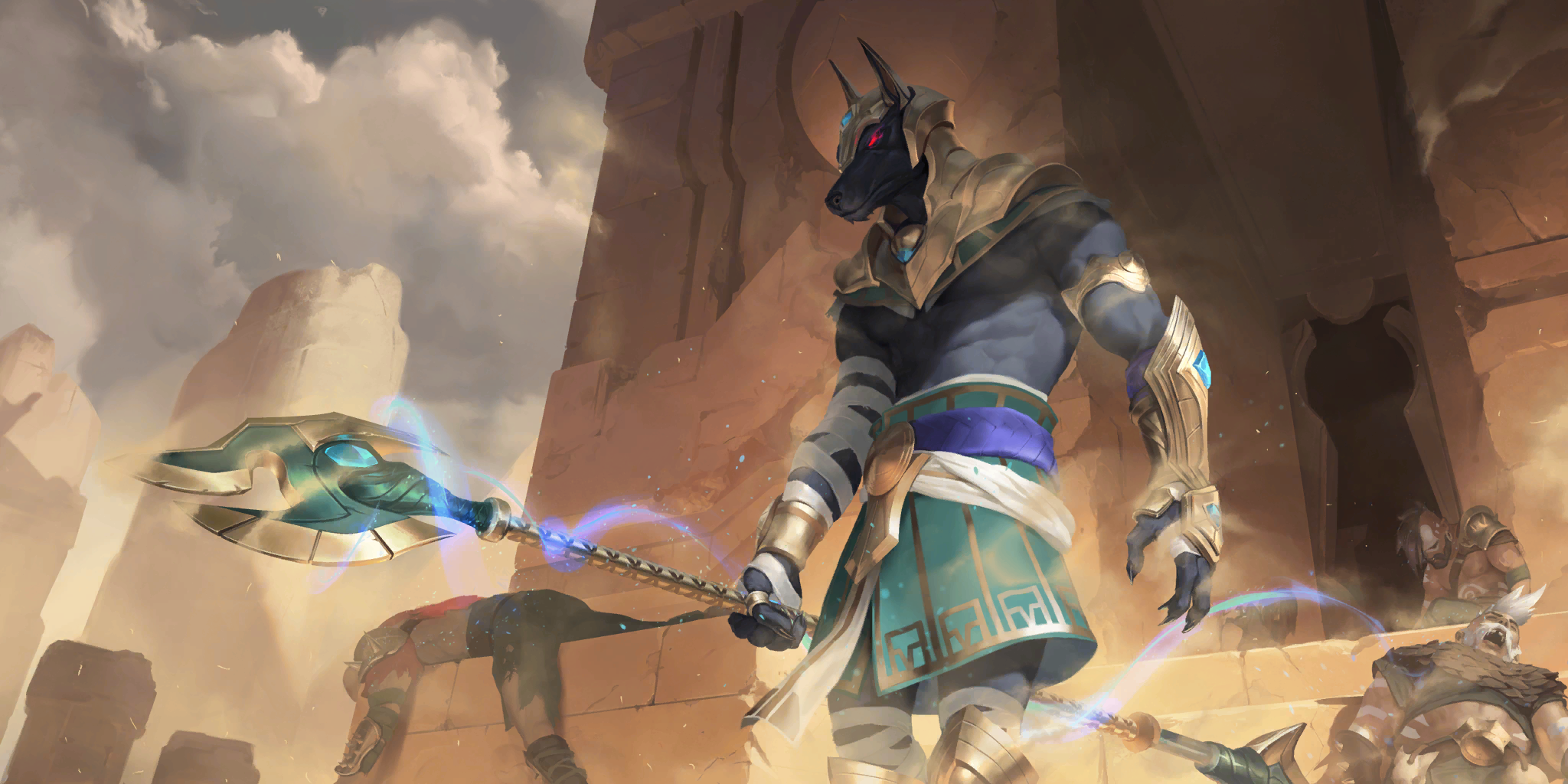


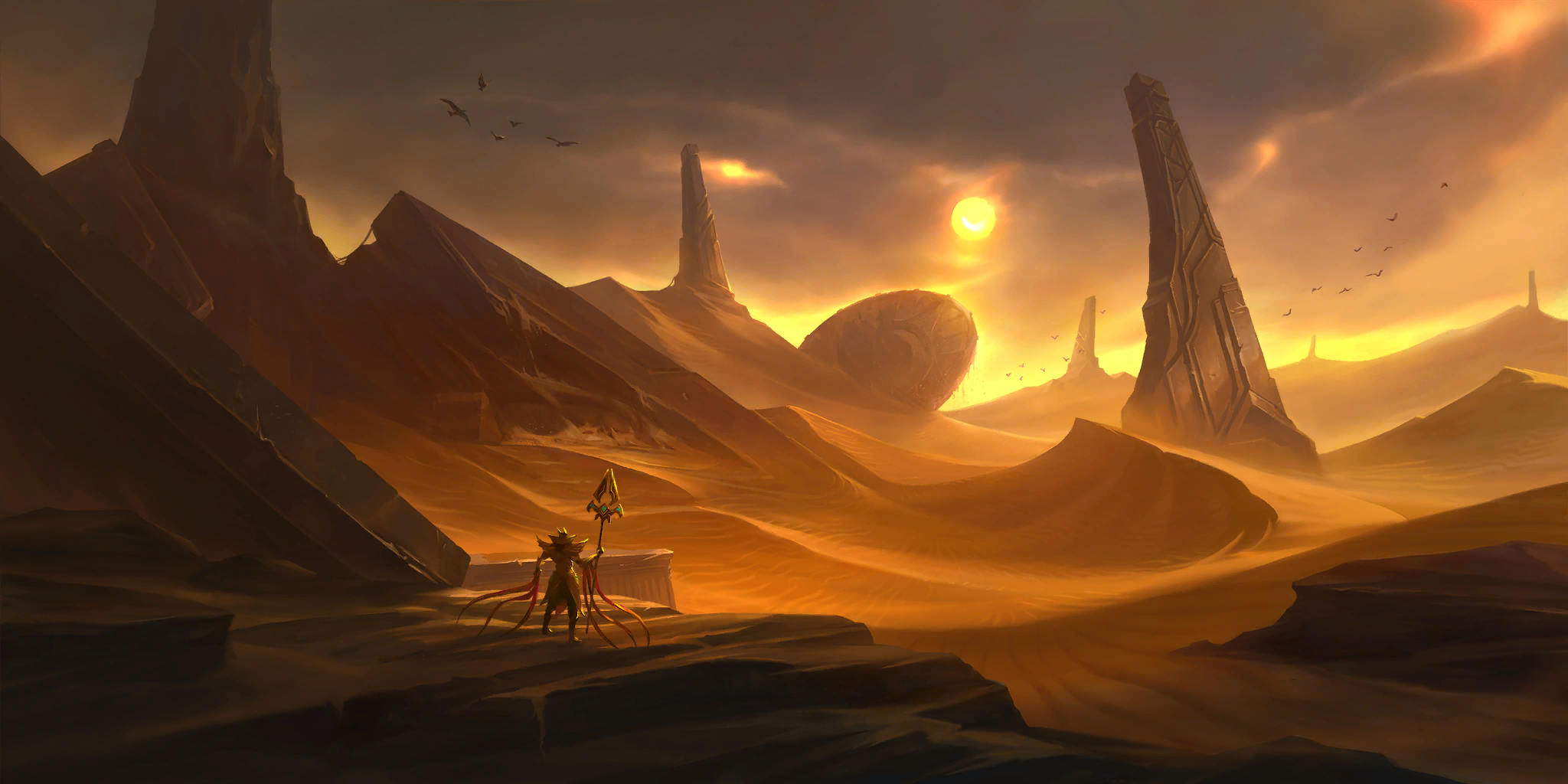


Baccai Reaper is the part people skip, and it is the one that belongs to a tomb crawl more than any of the champions do: “The baccai all fled or were spared following their failed Ascension, and none have seen them since. Who knows how long they have hidden in those dark tombs, bearing the mark of their shame?” Failed Ascensions, still down there, still hiding. That is a population for the lower floors that nobody has to invent.
Chamber of Renewal is the other loose thread, and it reads like a quest chain someone already outlined:
Nasus emerged from the sarcophagus, his mind clear and his wounds fully healed. He scribbled a few notes and peered at the sarcophagi hanging high above, pondering the mental state of the beastly aberrations resting within. Time would tell if this magic could bring the baccai back from their insanity, a magic the other Ascended had once protested. But they were gone now and Renekton and his madness were not. Nasus scribbled a few more words, hoping he had finally found a way to save his brother.
Flavor text on Chamber of Renewal
Sarcophagi hanging high above. Aberrations resting in them. A curator taking notes on whether the magic can bring a mind back. Read that as a room and you have vertical layout, an enemy population, and a reason to be there other than gold.
The Guide, the Curator, and the Man Behind the Door
Riot recorded the dialogue for this too. These are on the record, verbatim from our archive.
The mercenary who guides people down, and the brother who sealed the door
Sivir: “So, what secrets do your tombs hold, Nasus?”
Nasus: “Tread lightly. The tomb holds hidden danger.”
The emperor wants her out of the crypts. She likes it down there.
Azir: “Leave these tombs. Your throne awaits.”
Sivir: “My empire's the desert, and all its riches are mine.”
What the seal actually cost, in the words of the two it was built for
Xerath: “See what has come of abandoning your brother?”
Nasus: “You are my brother, Renekton, not my enemy.”
Renekton: “You are too late, brother.”
A stoneweaver who has seen this door closed before
Taliyah: “Stone sealed your tomb once. It will again.”
Lines pulled verbatim from our voice-line archive. Tap to play.
Sivir asks what is down there. Nasus, who knows because he shut the door, tells her to tread lightly. That exchange is a dungeon briefing between the two people best placed to give one, and it exists as audio.
The Day the Map Moved
The reason all of the above sits under an asterisk: the geography of this region is not fixed. Riot has already shown the terrain rewriting itself once, in Shurima: Rise of the Ascended.


The narration in that cinematic is about a journey, not a battle. With Sivir bleeding out on the tomb floor, Azir has one destination in mind:
He must take her to the Oasis of the Dawn - the Mother of Life. He smells the waters - smells of life. He prays he is in time.
Narration from Shurima: Rise of the Ascended
He is not teleporting. He is smelling for water and hoping the distance is short enough, which is the same problem the dormun solves for a whole village. Then the last shot happens and the capital comes up out of the sand with the Sun Disc over it.

The ancient capital is on our atlas as restored. The tomb underneath it is still listed as sealed, even though the same entry records the seal being broken once already, the breach that let Renekton out and set Xerath loose. A restored capital sitting on a tomb that has already failed once is a strange and very playable state for a zone to be in.
What This Says About Scale
Traversal design tells you how big a world thinks it is. A game that hands you a flying mount at level ten is telling you the space between things does not matter. Shurima's canon says the opposite at every rung.
Nothing in the region flies. The fastest thing available is an animal on a fixed route you have to learn, and the most comfortable thing available moves at the pace of a plodding herbivore looking for water. Distance is the content. The Great Sai is measured in full moons in Zaifa's diary, not in minutes.

Then the tomb takes all of it away. You give up the mount, the route knowledge, the moving village, and walk into passages that killed most of the people who tried. An MMO zone that spends an hour teaching you to move fast and then makes you go slow at the door is doing something almost nobody does anymore.
None of this is a plan Riot has published. It is a region with an unusually complete answer to a question most fantasy settings never bother asking, sitting in a game that has not shown gameplay since the reset. Read it as raw material rather than a roadmap.
Walk In, or Ride In?
If the MMO made you dismount and walk the last stretch into the Tomb of the Emperors, would that land as tension or as a chore?
Nothing above is confirmed. Sources: our Atlas of Runeterra entry for the Tomb of the Emperors, the Ascended encyclopedia entry, our Shurima region galleries, and Legends of Runeterra card text, all built from Riot's own canon. A RuneGrove lore read.


