

Riot’s Narrator Says Shurima’s Rise Was Worse Than Its Fall
Riot’s own narration calls the capital’s rise a worse tragedy than its fall. The risen city is empty, and that is the piece’s case.
Riot opens its cinematic Shurima: Descent into the Tomb, the story of a raid on the royal tomb beneath the old capital, on a strange line: "The tragic fall of Shurima was nothing, compared to the tragedy of its rise from the grave." The fall it means is the day the Ancient Shuriman Capital, the seat of the Shuriman Empire, burned and sank under the desert. The rise is the day Azir, its last emperor, came back as a god and pulled it out again.
Our atlas entry for the capital ends on the problem with that rise:
The restoration remains incomplete in life, however: the reclaimed city stands largely empty, a monument raised from the desert that has not yet been filled again with the people who once made it the wonder of the world.
Source: Ancient Shuriman Capital, RuneGrove Atlas of Runeterra
The narrator is right, and the canon shows why in order. The city came back without the people it was built for. Its way back in was a knife in the back at a tomb door, its only living heir ran from it, and the first thing its emperor made the sand do was act out its death again. That order is also a dungeon, and Riot has staged every wing of it.
The city came back without the people it was built for.
The Sun Disc Was Built to Make Gods, and It Unmade the Capital
The Sun Disc made the Ascended. Azir forced the ritual, freed every slave on the dais, and Xerath’s theft of it burned the city.
Everything in the capital turned on the Sun Disc, the colossal golden disc that our atlas says "hovered above the capital city, allowing the Shurimans of old to draw upon raw celestial magic and make their land bountiful." Its real purpose was Ascension, the ritual that turned mortals into the Ascended, Shurima’s god-warriors. In our entry on Sun Disc Ascension: "To Ascend, a worthy candidate stood beneath an activated Sun Disc while celestial fire remade them into an Ascended being of immense power." The same entry names the price: "it is irreversible and can fail catastrophically, as Xerath’s case shows; and it severs the Ascended from their humanity."
Azir’s creed puts the disc above the empire itself, on the Legends of Runeterra card Defenders of the Sun Disc:
"We are the keepers of the everlasting desert, the living history, the walkers of the path of radiance. We kneel before the Sun Disc and naught else, so that the world will kneel before Shurima’s glory." - Azir
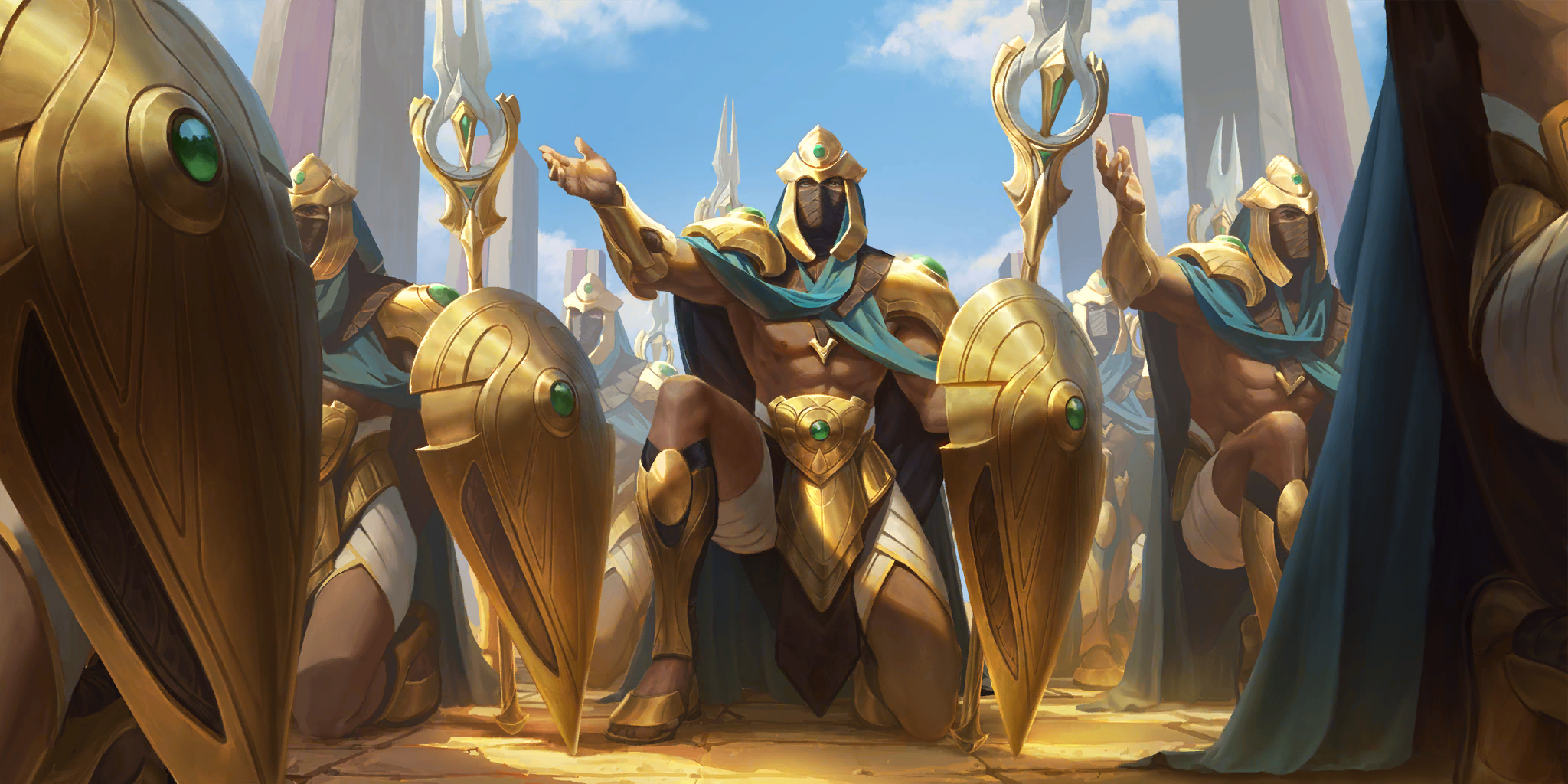
The ritual was a reward for the old and the faithful. In Azir’s biography, "It was for the Sun Priests to decree who would be blessed with Ascension, not the hubris of an emperor to bestow it upon himself." Azir ordered the priests to perform it on him "on pain of death." Beside him stood Xerath, a slave boy he had met in the Great Library and named, against the empire’s law, "one who shares." On the dais, in front of "tens of thousands of his subjects," Azir kept a promise he had made as a boy:
He climbed to the great golden disc atop the temple at the heart of the city and in the moments before the sun priests began the ritual, he turned to Xerath and finally freed him. And not just him, but all slaves…
Source: Azir, biography
Xerath had been studying sorcery in secret. He blasted Azir off the dais and took the light, and a ritual built for someone else tore the city apart: "Its people burned to ash and its towering palaces fell to ruin as the desert sands rose up to swallow the city." Scribe Kah’nir, the historian whose lines run through the Shurima cards, puts it on Azir: "In that fateful moment Shurima was cursed, doomed to ruin for thousands of years to follow."


Our read: whoever in that crowd had been a slave when the ritual began died free when it ended. That is the fall. The rise had to beat it.
The Way Back In Was a Knife at a Tomb Door
Sivir led a Noxian noblewoman through the catacombs, took a dagger at the tomb door, and the opened tomb released Renekton and Xerath.
Nobody found the capital for thousands of years. Then Sivir, a Shuriman mercenary who made her living robbing the old empire’s graves, took a job from Cassiopeia, a Noxian noblewoman, "to help plunder Shurima’s lost capital." Sivir carried the Chalicar, a cross-shaped blade she had "pried from the sarcophagus of some hero of the old Shuriman empire." The cinematic follows them down.

The Sivir biography gives the route. "As they traversed twisting catacombs, many of Sivir’s mercenaries fell to ancient traps, but Cassiopeia refused to turn back." At a great tomb door "surrounded by statued guardians and bas-reliefs depicting the mighty god-warriors of old," Cassiopeia put a dagger in Sivir’s back and used the Chalicar on the lock. The narrator’s version is five words: "The ancient weapon is a key." The lock was cursed, and "a stone serpent came to life before her eyes, searing Cassiopeia’s skin with venom."
Source: Sivir, biography
Behind the door was the Tomb of the Emperors, which our atlas calls "a vast necropolis buried beneath the sands of Shurima’s capital." Two Ascended were inside. After the fall, Renekton, the warrior who had trained Azir, dragged Xerath underground and had his own brother, Nasus, seal them in together. For centuries Xerath "whispered poison in Renekton’s ear." Kah’nir’s line on Renekton: "It only fueled his rage, made him stronger." On Xerath, the plotting "in the dark of the Emperor’s Tomb" ends with him marching on Shurima "just as Azir has revived it."


Our read: the rise began exactly the way the fall did, with a trusted companion turning on the person beside them at the moment of a ritual. The door let out the two men the city fell with.
Azir Woke Saving a Stranger, and the City Rose Around Him
Sivir’s blood woke Azir. He healed her at the Oasis of the Dawn, the city rose, and his only heir fled it.
Sivir’s blood did what nobody meant it to. The narrator of Shurima: Rise of the Ascended: "For though she does not know it, Sivir is the last in the bloodline of Azir, Shurima’s lost emperor." Her blood woke him, and the first thing he did was not about the empire: "In that moment, he has no thought of empires or rituals. He only knows: she needs his help."

He carried her to "the Oasis of the Dawn - the Mother of Life," the pool our atlas names as the source of the Mother of Life River. The basin was dry, "but with every step Azir took, clear water began filling the rocky basin." He healed her, and "with that act of selflessness, Azir was lifted up in a column of fire as the magic of Shurima renewed him." Then "Azir lifted his arms and his ruined city shrugged off the dust of centuries spent beneath the desert to rise anew."
Source: Azir, biography


That is the one clean moment in the rise, and it lasts until Sivir opens her eyes. Her biography: "Shaken to her very core, Sivir fled with the Chalicar on her back." The last of Azir’s blood walked out of the capital the day it had a sun over it again.
His First Act in the Risen City Was to Watch It Die Again
Azir used the risen city to replay Xerath’s betrayal in sand, then filled it with a sand army. The people it was built for are still missing.
With his capital back, Azir did not open the gates. He climbed the temple and made the sand perform the betrayal:
Azir climbed the steps of the newly-risen sun temple, weaving the desert winds to recreate the city’s last moments. Ghosts formed of sand relived his city’s last moments from long ago, and Azir watched in horror as Xerath’s treachery unfolded.
Source: Azir, biography
Then he filled the streets from the same material. Our Sand Soldier entry calls them "magical sand constructs summoned by Emperor Azir to form spectral armies." On the card Sand Soldier, his legions "are truly innumerable" now, and the landmark General’s Palace gives the city’s herald, the Voice of the Risen, the only census it offers: "his army only grows. Shurima is risen, and it shall never fall again!"


Xerath, free and Ascended, is the one who says what an empty city of soldiers means. Their recorded exchanges in Legends of Runeterra:
Azir and Xerath on opposite sides
Azir: “Men die, but Shurima lives forever.”
Xerath: “On the pages of history books alone.”
Azir and Xerath on opposite sides
Azir: “My name will echo through the ages.”
Xerath: “Cursed by those who suffered at your hands.”
Azir and Xerath on opposite sides
Azir: “Do not see what is. See what will be.”
Xerath: “Still the foolish boy, chasing the sun.”
"Do not see what is" is the risen capital in four words. Riot’s region gallery does title one panel "Shurima’s people return to their ancestral home," so the road in is open. Our atlas still says the city "has not yet been filled again." The water, the sun and the emperor came back. The people it was built for did not, and what walks its streets is sand that obeys and ghosts that replay.

The Dungeon Runs in the Order the City Rose
Three wings in canon’s order: the catacombs and the cursed door, the oasis where Azir woke, and the dais where the sand replays the betrayal.
Every room below is one canon already staged, in the order the rise walked through it. The rooms and the lines are Riot’s. The mechanics and the loot are our pitch.
Wing 1: The Catacombs and the Serpent Door
Our atlas sets the tone for the whole wing: the tomb’s "passages are guarded by traps and heaped with the treasures of the greatest empire Runeterra has ever known, and of the many raiders who have sought to plunder them, few have returned alive." The four Legends of Runeterra landmarks on our capital page read like trash-pack notes. Ancient Preparations has automata "precisely placed, simply waiting to be awakened." Roiling Sands says only Shurimans know "which expanses will stand firm, and which give way."
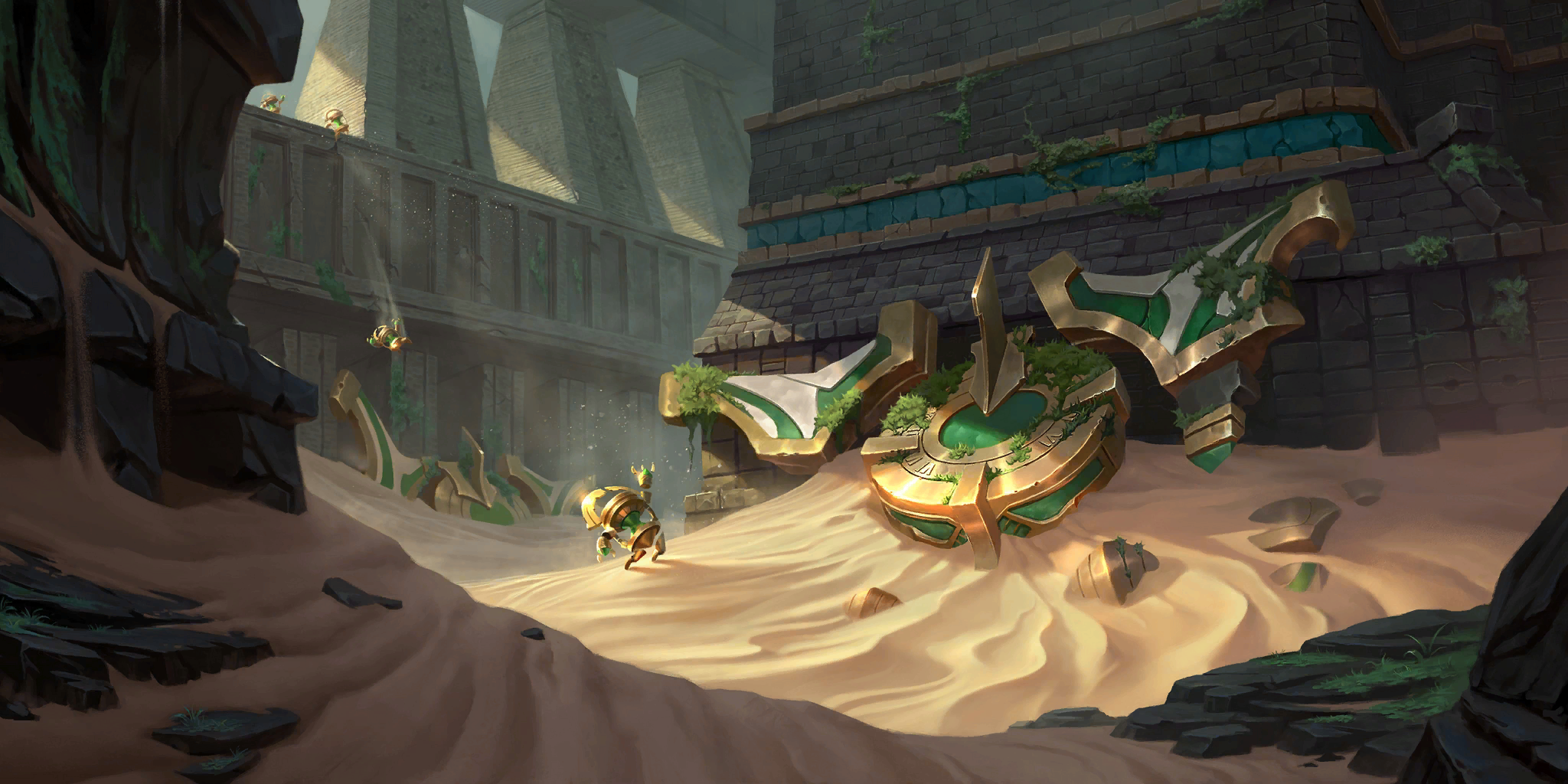
The mid-boss is the door. Its mechanic comes straight from Sivir’s story: it opens only for a relic blade, and whoever turns that key takes the stone serpent’s venom. Behind it waits Renekton, and the wing’s end fight is his rage, a timer that grows the longer the party stays in the dark with him.
Wing 2: The Oasis of the Dawn
Canon’s midpoint is a rescue, so this wing is one. The party carries a downed ally across the sand, the pool rises only while they keep moving, and the wing ends when the water is full. No boss: in the one moment the rise got right, Azir "has no thought of empires or rituals."
Wing 3: The Dais of Ascension
The final wing is Azir’s replay, played for the party instead of for him: sand ghosts re-running the ritual at the top of the temple. The biography gives the core mechanic in one line: "Without the protection of the runic circle, Azir was consumed by the sun’s fire as Xerath took his place." Stand inside the circle when the light comes down, or burn.
The adds are Sand Soldiers, and a garrison canon calls innumerable is a losing race, so the fight is won on the ghosts, not the army. The last phase is the replay breaking: the real Xerath arrives, because his card has him marching on Shurima "just as Azir has revived it."
The loot
The loot identity is Sivir’s trade. Her Chalicar was pried from a dead hero’s sarcophagus, and it opened the curse on the door. So every drop in the capital is a grave good from the age of the Ascended, and the best of it carries the tomb’s curse with it. Salt Spire, the fourth landmark on our capital page, already has the tooltip: a Shuriman "quickly learns which deposits are suitable for collection, and which are best left alone."
The capital’s bosses, from Legends of Runeterra
Renekton
ShurimaWhy it is a raid boss: Wing 1’s end. Sealed in the tomb with Xerath, and by his card’s account stronger for every year of it.
Sand Soldier
ShurimaWhy it is a raid boss: Wing 3’s adds. Canon calls them innumerable, so the fight is never won by clearing them.
Xerath
ShurimaWhy it is a raid boss: Wing 3’s last phase, when the ghost of the betrayal gives way to the man who marches on the revived city.
What This Means for the Riot MMO
The dungeon is the capital’s past. Its present needs people, and filling a city with them is what an MMO does.
The dungeon is the capital’s past, and Riot has already written it. The tragedy the narrator named is the capital’s present: a city with its sun and water back and nobody in it but soldiers who cannot refuse an order. Nasus, the Ascended scholar whose Great Library Azir grew up in, puts that to Azir on their shared cards:
Nasus and Azir on opposite sides
Nasus: “I will not see Shurima bow to a tyrant.”
Azir: “No, you will see it rise with its Emperor.”
A city of Sand Soldiers only proves Azir right, because sand cannot leave. Filling a city with people who can is the one thing an MMO does that no other Riot game has done. Players who walk in, stay, and could walk out the way Sivir did are the answer the capital’s canon has been waiting on.
Our read. Put the dungeon under the city and the players in its streets, and leave the streets unfinished. The tomb is Riot’s tragedy already written. Whether the rise ends as one is the part only people can settle.
Rebirth or Tragedy?
Azir raised the Shuriman capital from the sand, and his heir fled it. Was its rise a rebirth for Shurima, or a tragedy worse than its fall?
Read Next
The biography this piece stands on, and more Shurima from RuneGrove.


None of this is confirmed. Sources: our Atlas of Runeterra entries for the capital, the Sun Disc and the Tomb of the Emperors, the Azir and Sivir biographies, the Descent into the Tomb and Rise of the Ascended cinematics, and Legends of Runeterra card text and voice lines. A RuneGrove lore read.


