
Source: Game Informer's BlizzCon 2026 interview with the World of Warcraft: Forever team on YouTube, published September 16. Quotes are the video's own caption text, each with the clock, and the video is embedded at every moment discussed.

The Case for the Long Way Round
Mills on the flight path, the dungeon run and the question in general chat: the time the genre removes is the time Blizzard keeps.
What if the boring stretch of an online game is the part doing the most work? A Blizzard engineer made that case on a couch at BlizzCon last weekend, and it is the most useful thing anyone at the studio said about its new game. Blizzard is the studio that makes World of Warcraft, the long-running online role-playing game known as WoW, and World of Warcraft: Forever is the new version of it, built on the 2004 original and expanded rather than replaced. BlizzCon is Blizzard's annual fan convention, held this year on September 12 and 13.
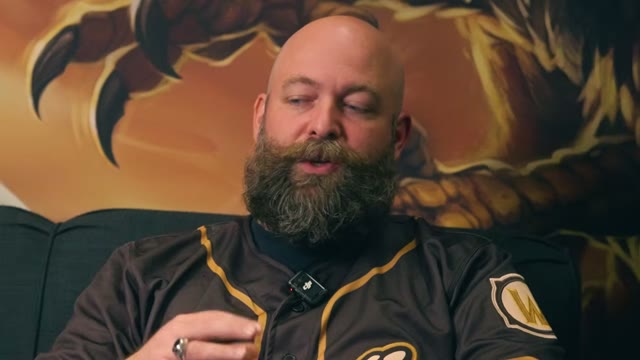
Game Informer, the American games magazine, sat two of the game's leads down after the show: lead game designer Tim Jones and lead software engineer Nora Mills. The interview runs 22 minutes and went up on September 16. Most of it is the expected tour: new zones, new lighting, add-ons, the price of an elf. Then, around the 13-minute mark, Mills starts describing a flight path, the long automated ride between towns that the original game made you sit through, and she keeps going for a minute and a half without anyone asking her a question.
The passage is worth quoting at length, because it is a designer's argument delivered by the person who has to make the servers pay for it.
It kind of mimics the ways in which original classic WoW led to these serendipitous moments where you're engaging with other players. For example, when I jump on a lengthy flight path, I might decide I'm going to talk to my guild, to have some conversation. Maybe I'm flying through a zone and someone asks a question in general chat. I'm going to answer the question. Same thing with if I'm running to a dungeon.
— Nora Mills, lead software engineer, Game Informer's interview, BlizzCon 2026, 12:56, watch
Then she makes the case against herself, the way someone who has sat through the meeting makes it. Looked at as a spreadsheet, the ride is waste. The player is not choosing anything, not solving anything, not engaging with a system. The genre has spent most of two decades treating that as a defect and patching it with more flight points, faster mounts and a teleport to the dungeon door.
If you look at it at face value and you're trying to think, oh well, but it takes time and the player's not making interesting choices or doing active problem solving or anything. They're not engaging with these systems during that time, they're just running. If you look at that at face value, it can be tempting to want to do something about it and make it, well, we'll add more flight paths, we'll make that run less, we'll reduce that friction.
— Nora Mills, lead software engineer, Game Informer's interview, BlizzCon 2026, 13:33, watch

And then the answer, which is not that the wait is fun. It is that the wait is where a player decides whether to be alone.
We look at it as, those are key to providing you with opportunities to slow down a little bit, decide, do you want to engage with other players? If someone's bored and they're posting in local defense and they're just like, hey, this guy over here is flagged, does someone want to come help me go after him? Maybe I'm going to take a detour on my dungeon run and I'm going to go help that person out, and maybe we're going to strike up a friendship, or a rivalry with the guy I just ganked.
— Nora Mills, lead software engineer, Game Informer's interview, BlizzCon 2026, 14:05, watch

Read the three passages together and it is one design. The flight path keeps you in your seat. The dungeon run makes you cross a zone on foot. The general chat question and the local defense call are not things the game does. They are things the game leaves room for. Blizzard is not defending boredom. It is defending the only minutes in which a server is a place rather than a queue.
Blizzard is not defending boredom. It is defending the only minutes in which a server is a place rather than a queue.
The Fire That Needs You Seated
One cooking fire, objects from four other professions, and buffs you only get by sitting down for a minute.
The campfire is the built version of the argument. Forever has a camping system, and it grows out of the cooking fire that the cooking profession has always been able to craft. Jones explained what is new: the fire now takes objects from other professions, and each one adds a bonus for everyone sitting around it.
The cornerstone of the campfire system is the cooking fire that the cooking profession crafts, but we have a new system where a cooking fire can accommodate a certain amount of extra objects that are crafted by other professions. So if you're a skinner, if you're a miner, if you're a blacksmith, if you're a leatherworker, you can bring different things that provide different bonuses to people.
— Tim Jones, lead game designer, Game Informer's interview, BlizzCon 2026, 12:18, watch
Then the sentence the system hangs on. The buffs do not land as you walk past. You sit, and Jones said the sitting is the point.
You have to sit down for a minute to get these buffs on you. And the hope is that in that interstitial space when people are waiting, you run into someone that might be on the same quest as you. And maybe that turns into a friendship. Maybe you join that person's guild. Maybe you're raiding together. Maybe you're going to BlizzCon together in a year.
— Tim Jones, lead game designer, Game Informer's interview, BlizzCon 2026, 12:42, watch

Mills had set it up a minute earlier, and her version is franker about what the fire invites. Sitting down makes you visible, to friends and to the other faction.
Our camping system is another way that you can do that, right? Because we sit down at a campfire, maybe you're going to come take advantage of my buffs, maybe you're going to gank me, I don't know. But it's just wonderful. You can imagine it as just sort of a staging ground for all of these really awesome potential opportunities to engage with other players in a variety of ways.
— Nora Mills, lead software engineer, Game Informer's interview, BlizzCon 2026, 11:40, watch

So the mechanic is small. One fire, four other professions feeding it, a buff that needs you seated. The design is not the fire. It is the minute, and what Blizzard expects to happen in it, which is exactly what it expects to happen on the flight path. RuneGrove's first read of this interview went deep on the fire itself; this piece is about the rule behind it.
The Stranger You Keep Meeting
No realm list, so the world logic is being tuned to show you the same players again, and never to drop 40 Horde on a lone quester.
The obvious objection is that Forever has no realms to be neighborly on. Blizzard deleted the realm list and replaced servers with rule sets and a world logic that distributes players, and a world that shuffles you among strangers is a poor place to build a reputation. Mills said the logic is being tuned against that, starting with the fight you did not ask for. The Horde, for anyone new to the game, is one of its two player factions; the Alliance is the other.
We're also leaning into faction balance. In PvP situations, we don't want there to be a world in which our world logic that's distributing players throughout the world is deciding, well, I see you questing there, doing your own thing, I'm going to decide to throw in like 40 Horde who are going to come after you and just mess you up. It's going to be a little more balanced, such that at least maybe you'll have more of a fighting chance, and that there's more social context involved too, so that you can encounter some of the same players more often and have that mega realm neighborly vibe. Maybe Tim's building a reputation for stealing my herbs or something.
— Nora Mills, lead software engineer, Game Informer's interview, BlizzCon 2026, 14:53, watch
The herb thief is the tell. A world that wants you to recognize the person who keeps beating you to a node has decided that repeat encounters are worth more than perfect load balancing, and the 40 Horde the logic must never drop on a lone quester are the other half of the same rule. On a PvP rule set you are held to one faction, Jones confirmed a moment earlier, so the neighbor you keep meeting can be the one you keep fighting. Mills closed the thought with the line that explains the whole interview: those are the relationships that matter.

Journey Before Destination
A level cap of 60 that never moves, 30 minutes a week that still count, and the pillar Blizzard names out loud.
The same rule runs through the whole game at a larger scale, and it is the reason the campfire is not a gimmick. Forever caps characters at level 60, and Blizzard has said the cap will never move. RuneGrove read the progression panel for what replaces it. Jones put the consequence plainly: when the finish line does not move, you are allowed to walk, and 30 minutes a week still counts as playing.
But the beauty of a game where the level cap is static and never moving is that you can take the game at your own pace and that's okay. The progress, the finish line's not moving, right? So people will be able to take the game at their own pace, put deliberate time into progression. If you only have 30 minutes during the week to play, then you can log in, look at the quests in your logs, complete a couple in Elwynn Forest, go to the auction house, grab a couple materials, make some progress on your professions. One of our core pillars is journey before destination.
— Tim Jones, lead game designer, Game Informer's interview, BlizzCon 2026, 8:40, watch
Put the four passages side by side and the pattern is hard to miss. A cap that never moves, a fire that needs a minute, a flight path kept long, a world logic that shows you the same faces. Each one spends a little of the player's time on purpose, and each one spends it on the same thing: the chance that the person next to you turns out to matter.
What This Means for the Riot MMO
Riot has posted one job about social systems and said nothing about travel; the world it draws on already has a fire every craft fed and a road every caravan shares.
Our read, and it is speculative. Riot Games has said nothing about travel, flight paths or how players will find each other in its MMO, the online role-playing game it confirmed in 2020 and reset in 2024. The one thing on the record is a job. On July 31 Riot posted a Staff Software Engineer, Social and Store listing, tagged to Riot Discovery, the studio Riot has attached to the MMO, to "architect the foundational social and store systems" of an unpublished product with a team of two to four engineers, "adhering to our social safety standards." Sydney is where Riot has been stacking the MMO's engineers, and that listing tells you the plumbing is being built. It says nothing about whether the game will leave room for the minute.
The temptation for Riot runs the other way. Its company reflex is to remove waiting from everything it ships, and its own fans are already at war over a group finder button. Mills's test is the one worth carrying over: if a stretch of travel is where people answer general chat, shortening it deletes the conversation, not the boredom. Sea of Thieves is running the same experiment from the other end, switching off fast travel for a season to see whether its world comes back to life.
| Side by side | WoW: Forever | Riot's MMO |
|---|---|---|
| The wait | A cooking fire, objects from four other professions, buffs that need you seated for a minute | Not revealed |
| Travel | Flight paths and dungeon runs kept long on purpose, as the place you answer general chat | Not revealed |
| Who you meet | World logic tuned for repeat encounters and faction balance; one faction per character on PvP | Not revealed |
| Pace | A level cap of 60 that never moves; 30 minutes a week still counts | Not revealed |
| Social plumbing | Built into the 2004 game and its add-ons | A Sydney listing for a staff engineer to architect the foundational social and store systems, with a team of two to four |
Runeterra, the world League of Legends is set in and the one confirmed fact about the MMO, already has both halves of this design. League of Legends is the five-on-five battle game Riot built its catalogue on. Start with the fire. In the Freljord, the frozen north of the map, the Hearthblood were a people of master craftspeople who gathered on the slopes of Hearth-Home, at the base of the dormant volcano where the forge-god Ornn labors. Blacksmiths, architects and brewmasters came from all corners of the continent to work beside one fire, and Ornn answered their work with curt nods, frowns and, at his most generous, the single word "Passable." A fire that every craft feeds and that people cross a continent to sit at is not a WoW invention. In the canon Riot draws on, it is how a culture began, and Ornn's Forge, the great hall of roaring fire beyond the ruins of Hearth-Home, is still on the map.
Then the road. The Notai are the nomads of the Freljord, a people who travel in elkyr-drawn caravans from village to village bringing song and dance, one last celebration for everyone they meet as each winter's chill sets in. Nunu, the boy who now rambles across the Freljord with the yeti Willump, was raised in that caravan. Further south, in Shurima, the desert empire that covers the south of the map, Kenethet is a desert city on the northern edge of the deep sand, a notorious waypoint whose bone-souks draw armed trade caravans down from the north before they strike out across the Sai Kahleek, the most feared stretch of desert on the continent, its ground pockmarked with tunnels. That is the dungeon run and the local defense channel in one place: a crossing you do not make alone, and a stop where the crossings meet.
The Freljord even has the place where strangers become something else. Rakelstake, the principal settlement of the Avarosans, the largest and most diplomatic of the Freljord's tribes, welcomes travelers and traders and serves as a gathering ground where many tribes come to hear the words of Ashe, the Avarosan warmother. It was there that Braum, the wandering folk hero of the Freljord, planted himself in front of a beaten fighter with his shield raised and absorbed every blow until the barbarian Tryndamere's rage was spent. The friendship that followed is said to have introduced Tryndamere to the woman he would marry. That is the campfire story with the names changed: a place people pass through, and a wait long enough for two strangers to notice each other.
Take this
- Copy the wait, not the fire. A buff that only lands if you are seated is a reason to sit where other people sit; the fire is just the excuse.
- Let every craft feed one object. A skinner, a miner, a smith and a leatherworker each bring something, so a profession is a reason to be welcome rather than a private grind.
- Keep one stretch of travel long, and make it the stretch where chat happens. Mills's test is the honest one: if shortening it would delete a conversation, leave it alone.
- Show the same faces twice. Realmless is fine as long as the logic still lets someone build a reputation for stealing your herbs.
- Let the finish line stand still. A cap that never moves is what makes 30 minutes a week feel like progress instead of falling behind.
Leave this
- Waiting with nothing at the end of it. The campfire works because the buff is real and the crowd is real; a minute alone in an empty zone is a loading screen with extra steps.
- Friction only a veteran can read. Blizzard can keep a 2004 flight path because its players remember why it is there. A new game has to make the wait legible on day one.
- Balancing so hard that nobody ever needs help. If the world logic guarantees you are never outnumbered, the local defense call never goes out.

That map is the fiction Riot draws on, not a launch plan. Which regions the MMO opens with, how much of the map it covers, its era, its platform and its price are all unrevealed. The Freljord and Shurima are here because the canon that lives in them already answers the question Mills was answering: what a player is doing in the minutes the game asks nothing of them.
Your Take
Should the Riot MMO keep some travel slow on purpose?
What to Watch
Three dated Forever beats, then three more RuneGrove reads on the same convention.
World of Warcraft: Forever beta opens
Jones said he cannot wait for people to have those moments when they jump into the beta.
World of Warcraft: Forever launches
The first time the campfire, the flight paths and the world logic meet a full population.
The first new raids unlock
The first dated beat on the roadmap Blizzard showed at BlizzCon.


Reported from Game Informer's BlizzCon 2026 interview on YouTube, embedded above with the clock. The MMO read is ours and speculative. Analysis by RuneGrove.


