
Children of the Wild Magic: A Definitive Chronicle of the Vastaya
League of Legends | Lore Deep Dive
The Dawn of the Chimeras: A Mythic Origin
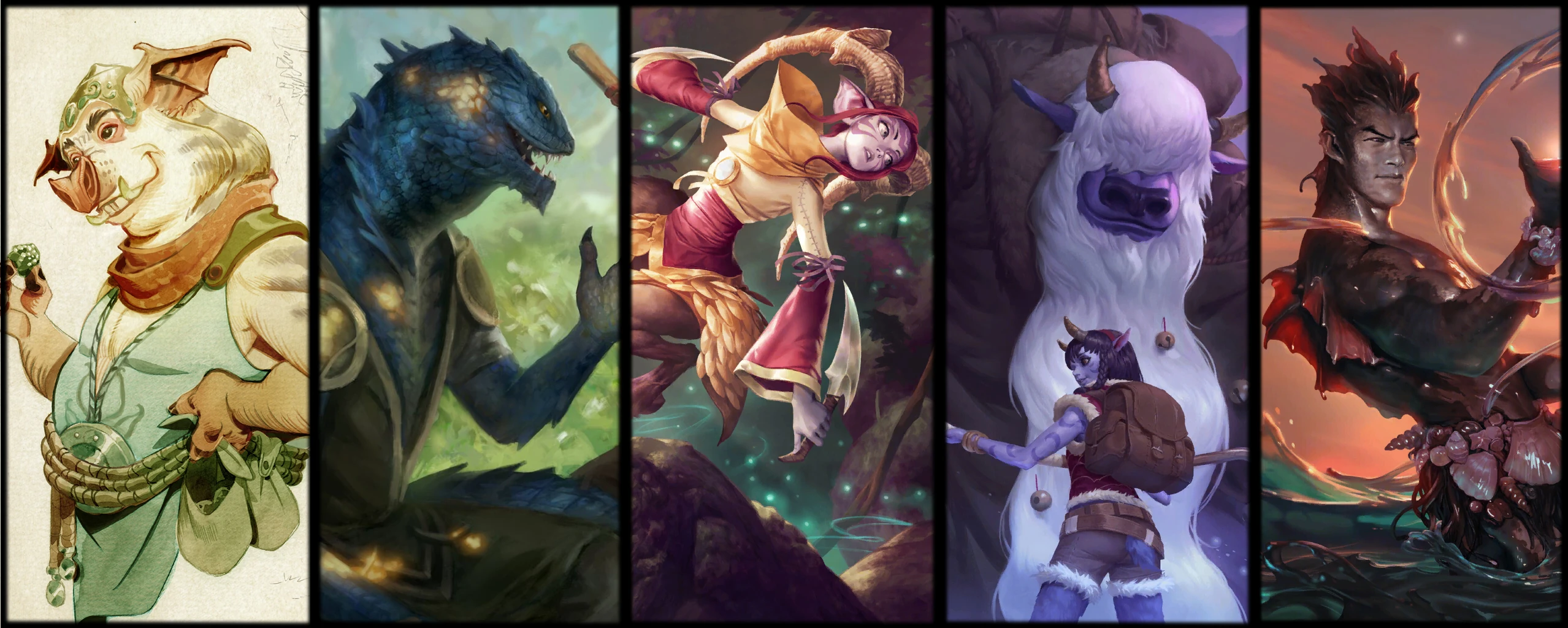
To understand the Vastaya, one must understand their origin in a Runeterra where the veil between the physical and Spirit Realm was thin. In the primordial era, the lands now known as Ionia were called the First Lands, a continent saturated with raw, untamed spiritual magic.

This "wild magic" was the lifeblood of the world, flowing in metaphysical rivers that shaped reality itself.
The First Lands and the Titan War
The balance of the First Lands was shattered by a cataclysmic invasion from the skies. A race of titans waged a devastating war against mortals, threatening to sunder the world.

An Ancient And Respected History.
It is certain Ionia has a much longer and richer history than any living soul could claim to know. Indeed, in the more remote mountain passes, the landscape is still littered with evidence of great wars from ages past—but instead of clearing the ruins, the Ionians choose to respect what remains, even if they no longer fully understand what it represents.
The mortals, though valiant, found themselves outmatched. This conflict became the crucible in which a new race would be forged.
The Birth of the Vastayashai'rei
Faced with annihilation, a group of enlightened mortals turned to the potent magic of the Spirit Realm.

They drew the raw power of the spirit world into their physical forms, a profound and irreversible fusion. These mortals were reborn as the Vastayashai'rei—deathless, powerful shapeshifters who could command the natural world as an extension of their will. They were mortals who had achieved ascension through a perfect synthesis with spiritual magic.
Wielding their new abilities, the Vastayashai'rei defeated the titans, saving the world and being hailed as heroes.
The Great Dilution: From Progenitors to People
After the war, the Vastayashai'rei chose to live among their mortal kin as equals rather than setting themselves apart as rulers. Over time, these magically-ascended beings interbred with the human population. The offspring of these unions were a new, chimeric people who were neither fully mortal nor truly immortal. They became known as the Vastaya.

This intermingling diluted the Vastayashai'rei's immense power. The Vastaya inherited a fraction of their ancestors' shapeshifting prowess and longevity, but they were no longer the deathless warriors of the Titan War. They did, however, retain an innate connection to the spiritual magic of Runeterra, a bond that remains the core of their identity.
This origin contains a tragic paradox at the heart of the modern Vastayan condition. The race was born from a harmonious union between magically-ascended humans (the Vastayashai'rei) and the mortals they lived alongside. Yet, a significant conflict for contemporary Vastaya, exemplified by revolutionaries like Xayah, is a deep-seated animosity towards humans for disrupting the wild magic the Vastaya need to survive.
The struggle is not a simple race war. Since the Vastayashai'rei were human first and chose to create the Vastaya through unions with humans, humanity is a foundational component of the Vastayan lineage. Therefore, the actions of Vastayan separatists are, in essence, a war against a part of their own heritage. Their fight to preserve the magic their human ancestors taught them to wield, against the descendants of the people their Vastayashai'rei ancestors embraced, frames their struggle as an internal identity crisis.

The "human problem" is inextricably a "Vastayan problem," a desperate attempt to define who they are in a world that has forgotten their shared history.
The Living Tapestry: A Vastayan Family Tree
As the threat of the titans faded, the power of the individual Vastayashai'rei waned. Their descendants, the Vastaya, spread out from Ionia, forming distinct tribes and cultures across Runeterra. This diaspora led to the incredible diversity seen in the Vastayan people today.
The Founding of the Tribes
The legacy of the Titan War heroes was not forgotten.

Mistfall Legends of Runeterra Card
"Mistfall is sacred ground. The swords at the site have been here for centuries... and it is my belief that any blade left here with a poem on its hilt will invite the spirits of lost wielders to imbue it with their blessing." - Disciple of Doran, handwritten scroll
Many new tribes adopted the names of the legendary Vastayashai'rei who had saved the world, creating a direct line of cultural and spiritual inheritance. The tales of "noble Kiila, dutiful Chyr, cunning Lhotl, and countless more besides" became the founding myths for entire peoples.
Over thousands of years, each tribe adapted to its environment, and their physical forms evolved to reflect their surroundings and the animalistic traits of their ancestors.
This, combined with their reliance on wild magic, led the Vastaya to settle only in regions where the connection to the Spirit Realm remained strong.
The greatest source of knowledge around vastaya is contained in Eduard Santangelo's Vastaya Field Journal.

Eduard Santangelo's Vastaya Field Journal
Chimeras with human blood? Spiritual magic from an ancient race? In my humble inquiries I have stumbled upon far greater questions...this shall make for quite the chronicle. A best-seller, in fact.
“Eduard Santangelo, gentleman of Piltover, explorer of Ionia, who discovered the wondrous vastaya in the wilds of Ionia.” I can already hear them clamoring for the first edition.
The Three Peoples: A Broad Classification
Vastayan tribes can be broadly categorized into three main classifications based on their physiology and habitat: tribes of the land, the sea, and the sky.
- Sea-dwellers: Tribes like the Marai are amphibious or aquatic, with mermadic features like tails and fins.
- Sky-dwellers: Defined by avian characteristics, such as the Chyra tribe.
- Landwalkers: The largest and most varied classification, encompassing chimeric forms based on felines (Kiilash, Vesani),

primates (Shimon),

avians (Lhotlan),

and reptiles (Oovi-Kat).

The following table provides an overview of the most well-documented Vastayan tribes.
| Tribe Name | Classification | Known Homelands | Physiological Traits | Named Ancestor | Champion Representative(s) |
|---|---|---|---|---|---|
| Marai | Sea-dweller | Seas west of Mount Targon | Mermadic, aquatic features (fish/dolphin-like) | Unknown | Nami |
| Kiilash | Landwalker | Eastern jungles of Shurima / Ixtal | Feline (big cat-like) | Kiila | Rengar |
| Shimon | Landwalker | Ionian magical forests | Primate (monkey-like) | Unknown | Wukong |
| Lhotlan | Landwalker | Ionian highlands (Island of Qaelin) | Avian/Feline hybrid (fox/gryphon-like) | Lhotl | Xayah, Rakan |
| Oovi-Kat | Landwalker | Remote eastern island (now destroyed) | Chameleon-like, floral appendages | Unknown | Neeko |
| Vesani | Landwalker | Blessed Isles (now Shadow Isles) | Feline (nine-tailed fox-like) | Unknown | Ahri (Last known) |
| Unnamed | Landwalker | Ionia | Wolverine-like | Unknown | Sett's Mother |
| Chyra | Sky-dweller | Unknown ("the silent chorus") | Unknown | Chyr | None |
"Vastaya" is not a monolithic term; it describes a spectrum of beings whose connection to their progenitors varies significantly, creating a gradient of magical purity and power. The Oovi-Kat tribe, for instance, remained isolated and mingled far less with humans. As a result, their bloodline is "almost completely undiluted," closer to the original Vastayashai'rei. This purity manifests in phenomenal magical abilities.

Neeko, the last Oovi-Kat, possesses exceedingly potent shapeshifting powers, allowing her to mimic almost any living creature with a perfection other Vastaya cannot achieve.
In contrast, most other Vastayan tribes have more fixed chimeric forms—Rengar is always feline, Nami is always mermadic.

Their shapeshifting is a distant echo of their ancestors' abilities. At the furthest end of this spectrum are individuals with only trace amounts of Vastayan blood, like Nidalee, who possess some shapeshifting ability but are not considered true Vastaya.

This genetic gradient suggests a potential social hierarchy within Vastayan culture, where tribes like the Oovi-Kat might have been revered for their purity, adding another layer of complexity to their struggle for identity.
Icons of a People: Vastayan Champions in Focus
The stories of Vastayan champions illustrate the culture, struggles, and existential questions facing their race.
The Lhotlan Rebels: Xayah & Rakan
The tale of Xayah and Rakan is the quintessential narrative of the modern Vastayan conflict. As members of the Lhotlan tribe, they wage a revolutionary war to reclaim their ancestral homelands in Ionia from humans.
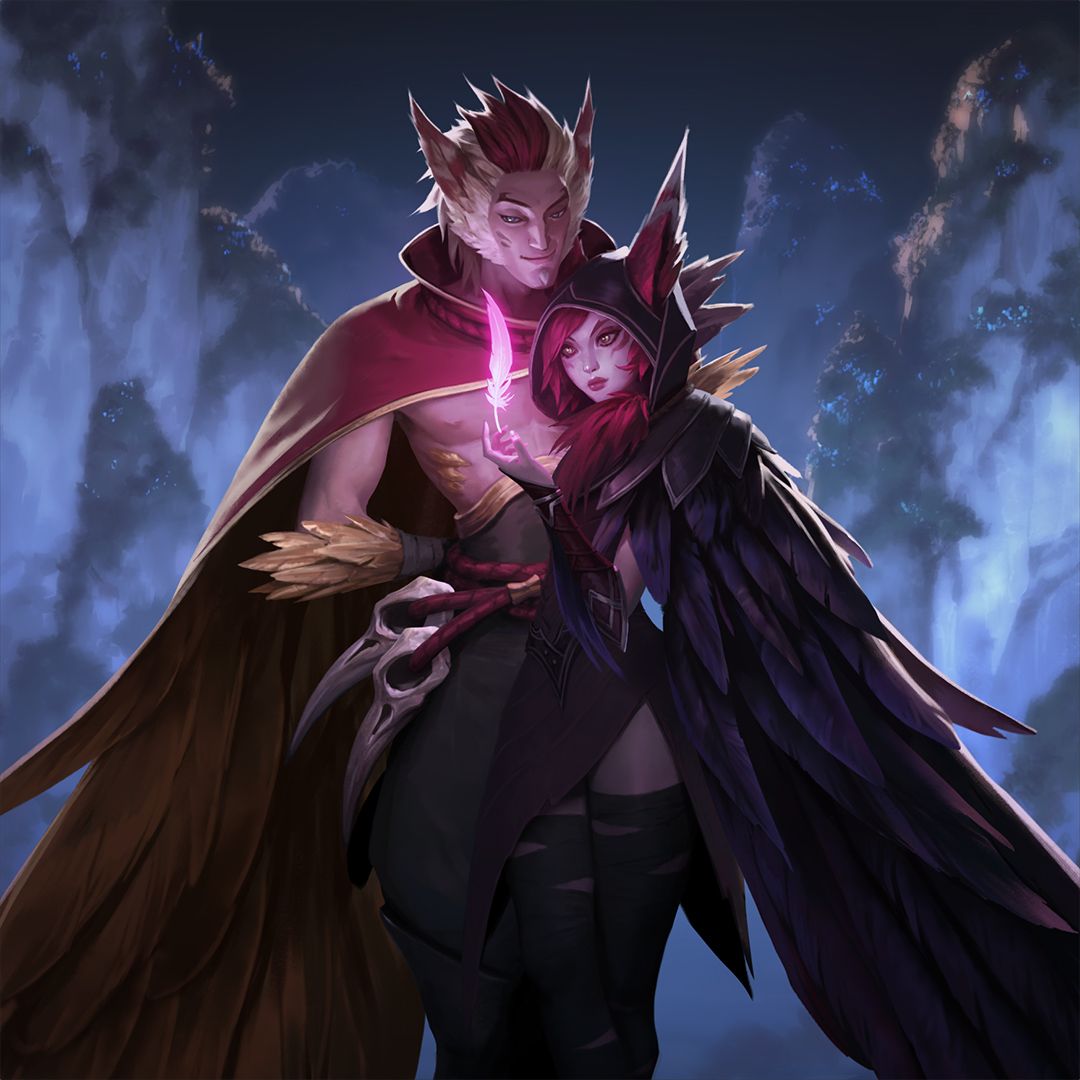
Their struggle is born from an existential threat: human settlements and technologies disrupt the natural flow of wild magic. For the Vastaya, who require this magic to thrive and reproduce, this disruption is a slow poison, causing their vitality to fade.
We see how desperate the Vastaya are to reclaim their homelands in the book Ambessa: Chosen of the Wolf.

After Ambessa captures the Ionian fortress in Kumangra, she finds a group of Vastayan prisoners. The prisoners explain that the human inhabitants of Ionia are "improperly using magic and defiling the natural forests with their intervention." This destruction directly weakens the Vastaya. In exchange for Noxian help in driving the human Ionians out of the Kumangra forest, the Vastaya offer Ambessa a strategic ocean entry point into Ionia.
Another example we see is with Xayah and Rakan.

Xayah, the "Violet Raven," is the heart of the rebellion, a freedom fighter driven by loss. She watched as treaties with mortals were consistently broken, driving the Lhotlan from their homes. Her crusade began when she returned to find her entire tribe had vanished, a disappearance linked to shadow magic corrupting a nearby temple. Rakan, the "Charmer," is the greatest battle-dancer in Lhotlan history. He found a deeper purpose after meeting Xayah, and his charismatic fighting style complements her lethal precision. Together, they represent a desperate struggle for cultural preservation.
The Kiilash Pridestalker: Rengar
In the jungles of Shurima and Ixtal resides Rengar, a fearsome trophy hunter of the Kiilash tribe.
The Kiilash built their society upon the honor of the hunt. Rengar's story is one of triumph over perceived weakness. Born the runt of his chieftain's litter, he was ignored and expected to perish. Instead, he fled and taught himself to hunt, pushing his will to its limits.
He returned as a master predator, eventually slaying his own father to become the new chieftain. Yet, Rengar found tribal acceptance meant little. The true prize was the thrill of the pursuit. He abandoned his title and now scours the world for the most dangerous prey, his ultimate goal being the void-creature Kha'Zix, the beast that took his eye. Rengar's journey showcases a culture where strength and self-reliance are the ultimate virtues.
The Shimon Monkey King: Wukong
Wukong, a Vastayan trickster from the primate-like Shimon tribe, offers a path of integration and self-improvement.
The Shimon believe life is an evolutionary climb to wisdom, and the impulsive Wukong was cast out for his pranks. He was eventually humbled by the human warrior Master Yi, the last practitioner of the martial art of Wuju. Wukong begged to become his student, and through Yi's teachings, he learned to channel his recklessness into a lethally swift fighting style. Wukong's partnership with a human mentor stands in opposition to Xayah's separatist ideology. His story demonstrates that strength can be found by embracing new disciplines and forming bonds with those outside their own kind.
The Marai Tidecaller: Nami
Nami's quest is one of desperate diplomacy, driven by a cosmic threat.

Her people, the Marai, are a mermadic tribe of sea-dwelling Vastaya living west of Mount Targon. The Marai's existence is threatened by a rift in the ocean—a gateway from which the life-exterminating darkness of the Void seeks to emerge.

Canonical sources consistently refer to the tribe as the Marai. Their existence is threatened by a rift in the ocean—a gateway from which the life-exterminating darkness of the Void seeks to emerge.


For centuries, the Marai have been protected by a celestial moonstone. Their survival hinges on a ritual: every hundred years, a chosen Tidecaller must retrieve an abyssal pearl from the Void rift and trade it with a Targonian wanderer for a new moonstone.

When the chosen Tidecaller failed to return, the young Nami took it upon herself to brave the abyss. She succeeded in retrieving the Abyssal pearl and saves her people from the Abyssal Darkness. For Now.
The Last Oovi-Kat: Neeko
Neeko's story is one of tragedy and optimism.
She hails from the Oovi-Kat, a lost tribe from a remote island whose bloodline was almost purely descended from the original Vastayashai'rei. They lived in harmony with the Spirit Realm, communicating through their spiritual essence, their sho'ma. This granted them unrivaled shapeshifting abilities.
This existence was annihilated by a magical cataclysm, leaving Neeko as the sole survivor. Despite her loss, Neeko's boundless curiosity has led her on a new quest: to build a new tribe. This tribe will not be defined by bloodline, but by like-hearted souls. She welcomes anyone—human, yordle, or Vastaya—who shares her dream of a harmonious future. Neeko represents a potential future for the Vastaya built on inclusivity rather than ancient lineage.
The Lost and the Half-Blooded: Ahri & Sett
The narratives of Ahri and Sett explore themes of identity and belonging. Ahri is the last known survivor of the Vesani, a tribe of nine-tailed fox-like Vastaya wiped out by the Ruination.

With no memories of her people, she lived as a wild predator, consuming the life essence and memories of mortals. This power became an addiction, and she saw herself as a monster. A tragic romance with a mortal artist, whom she accidentally killed, set her on a path to discover her origins and control her abilities.
Ahri's journey is a quest for redemption and self-discovery.
Sett, on the other hand, was born from the taboo union of an Ionian Vastaya and a Noxian human, making him an outcast.

His mother's community expelled the family, and humans treated the "half-beast" child with contempt, especially after his pitfighter father abandoned them. Sett channeled a lifetime of rage into the fighting pits, becoming an undefeated sensation. He eventually seized control of the entire operation, transforming it into a criminal underworld. Sett's story is a powerful allegory for carving out a place of power by embracing the very identity that society tried to shame.

A unifying theme emerges from these champions: the Vastaya are facing a species-wide crisis—a "Great Dying." The Oovi-Kat are destroyed, the Vesani are extinct, the Lhotlan are fading, and the Marai are one failed ritual away from being consumed by the Void. Official chronicles state: "No new vastaya have been born in several mortal lifetimes." This is an existential threat to their entire people.
In this context, the champions become avatars for competing ideologies on how to save a dying race. Xayah's path is violent rebellion. Nami's is desperate diplomacy. Neeko's is radical inclusivity. Wukong's is assimilation. Rengar chooses isolation, while Sett opts to dominate a human system from within. The future of the Vastayan people may depend on which of these strategies proves successful.
Beyond the Known Wilds: Other Faces and Mistaken Identities
While champions provide detailed portraits of Vastayan life, other members of this race exist, and the diversity of life on Runeterra has led to frequent misidentification.
A New Face in the City of Progress: Lest from Arcane
The series Arcane is foundational canon for the League of Legends universe. It introduced a new Vastayan character: Lest, an associate of councilor Mel Medarda in Piltover.
Lest's heritage is evident in her large, fox-like ears, which grant her superhuman hearing. She can easily overhear a whispered conversation from behind a locked door. Her presence is significant; it confirms that Vastaya are not confined to the wilds but can integrate into the heart of human civilization.
Defining the Boundaries: What a Vastaya Is Not
The mention of the Chirean from Arcane highlights a common confusion. "Vastaya" is not a catch-all for chimeric beings; it is a specific classification with a singular origin.
The key distinction is lineage. A being is only a Vastaya if they can trace their ancestry to the Vastayashai'rei. This heritage grants them their innate connection to spiritual magic. The Chirean, a species of bat-like humanoids from Zaun's deep caverns, do not share this origin. They are a distinct, non-magical species that evolved separately, with a "seemingly native understanding of technology." The bat-like members of the Firelights in Arcane are Chireans, not a lost tribe of Vastaya.


This principle applies to other races as well. Minotaurs, such as Alistar, are a separate and distinct people. Yordles, though magical and sometimes possessing animal-like features, are spirits from Bandle City. The term Vastaya is precise: it refers exclusively to the descendants of the Vastayashai'rei and their unions with humans.


The Future of the First Children: The Vastaya as a Playable Race
The rich lore surrounding the Vastaya provides a foundation for their implementation as a playable race in a Runeterra-based MMO. Their diverse tribes and struggle for survival offer a compelling framework for player identity and class design.
Character Creation: Choosing Your Bloodline
The tribal system is a perfect model for a "sub-race" selection process. A player would choose the Vastayan race and then a tribal lineage, determining their appearance and granting unique passive abilities.
- Tribal Choices & Potential Racial Bonuses:
- Kiilash: Feline features; bonuses to stealth, tracking, or movement speed.
- Marai: Aquatic features; ability to breathe and move at full speed underwater.
- Lhotlan: Avian and feline traits; a brief increase in movement speed after using an ability.
- Shimon: Primate-like features; enhanced agility or climbing ability.
- Half-Vastaya (Sett's Lineage): Subtle bestial traits; a passive tied to resilience or rage, gaining power as they sustain damage.
Class Identity: Magic, Might, and Metamorphosis
The Vastaya support a wide range of lore-rich class archetypes, many exclusive to specific tribes.
- Lore-Inspired Classes:
- Tidecaller (Marai only): A support/healing caster manipulating water to protect and heal allies, like Nami.
- Battle-Dancer (Lhotlan only): A mobile melee damage class weaving elegant movements with arcane strikes, inspired by Rakan.
- Pridestalker (Kiilash only): A stealth-based assassin or ranger excelling at ambushes, embodying Rengar.
- True Shapeshifter (Oovi-Kat lineage only): A complex "hero class" that could temporarily mimic the abilities of other creatures, drawing from Neeko's potential.
The Player Journey: A World of Conflict
A Vastayan player's journey would be rooted in the core conflict of their people.
- Starting Experience: The journey could begin in a tribal enclave—a Kiilash hunting camp or a Lhotlan grove. Initial quests would thrust the player into the Vastayan struggle: defending their home from human encroachment or purifying corrupted wild magic.
- Central Narrative: The overarching racial storyline would be the fight for survival. Players would be tasked with finding a solution to the magical infertility crisis threatening their race. This would involve uniting tribes, forging alliances, and confronting the forces causing the world's magic to fade, providing a powerful motivation for the player's entire journey.


